
categories
HOT TOPICS
- The Accelerator Conundrum
- The Startup Velocity Question
- Man and Superman
- Web 3.0 = (4C + P + VS)
- The Future: End of Capitalism
- Capitalism 2.0

7 Udemy Courses on How To Build an EdTech Startup

Online learning has exploded in popularity over the last decade. In Covid, the field has found a tremendous force multiplier.
Many founders are now turning to online education for startup ideas. Here’s why: it can be extremely profitable because online courses do not require physical classrooms, startup costs are more affordable and startup time frames are shorter. The ability to scale fast makes this space very attractive for new ventures.
>>>Featured Videos
Bootstrapping by Piggybacking: Evenica CEO Sadek Ali (Part 1)

Sadek has built an e-commerce platform company for the mid-market within the Microsoft ecosystem. Read on to learn more.
Sramana Mitra: Let’s start at the very beginning of your journey. Where are you from? Where were you born, raised, and in what kind of background?
Sadek Ali: I was born in Canada. I grew up there. Most of my adult life has been spent here.
>>>Building a 2-sided Farm to Table Marketplace from Indiana: Nick Carter, CEO of Market Wagon (Part 1)

Nick tells a wonderful story of building Market Wagon into a thriving marketplace. Covid has been an immense force multiplier for the venture.
Sramana Mitra: Let’s start at the very beginning of your journey. Where are you from? Where were you born, raised and in what kind of background?
>>>Video FAQs
Can 1M/1M Help Me Raise Money?
How Does 1M/1M Democratize Entrepreneurship Education?
How Does 1M/1M Democratize Management Consulting?
When Is The Right Time To Join 1M/1M?
Can 1M/1M Help Me With Business Development?
Can 1M/1M Help Me With Market Sizing?
Can 1M/1M Help Me Validate My Product?
Will I Have Private 1-on-1 Sessions In 1M/1M?
How Does 1M/1M Help Entrepreneurs Connect With Silicon Valley?
Mentoring or Consulting?
Why Does 1M/1M Charge $1000 a Year?
Why Does 1M/1M Partner With Local Organizations?
Why Don\’t Mentoring Networks Work?
Why Is It Important To Study With 1M/1M Now?
Dan Stewart Story
Vikrant Mathur Story
January 6 – 558th 1Mby1M Mentoring Roundtable for Entrepreneurs

Entrepreneurs are invited to the 558th FREE online 1Mby1M Mentoring Roundtable on Thursday, January 6, 2022, at 8 a.m. PST/11 a.m. EST/5 p.m. CET/9:30 p.m. India IST.
If you are a serious entrepreneur, register to “pitch” and sell your business idea. You’ll receive straightforward feedback, advice on next steps, and answers to any of your questions. Others can register to “attend” to watch, learn, and interact through the online chat.
You can learn more here and register to pitch or attend here. Register and you will receive the recording by email, even if you are unable to attend. Please share with any entrepreneurs in your circle who may be interested. All are welcome!
The Unbearable Heaviness of Being: On the Passing of Naren Gupta (Part 9)

On Christmas morning, Dominique and I had breakfast in bed and watched a film on Charles de Gaulle. It specifically focused on how, as the French President capitulated to Hitler, General Charles de Gaulle went to Churchill to reverse that decision and keep fighting in World War II.
In an unorthodox, typically Churchill way, he was supported. One single man. A man with no country, as France had taken away De Gaulle’s citizenship. One man with no resources.
One man with conviction.
The Unbearable Heaviness of Being: On the Passing of Naren Gupta (Part 8)

Our last free-flowing conversation was on November 14 in our garden.
I didn’t know that this would be the last time I would cook for him. I specifically cooked a lightly spiced Indo-French meal so as not to overpower the wine we were going to drink.
Like many Indians, Naren and I didn’t grow up drinking wine. However, we’ve learnt to enjoy good wine. Dominique, of Belgian-French origin, grew up in a wine culture. Naren always enjoyed the wines Dominique would introduce him to.
The Unbearable Heaviness of Being: On the Passing of Naren Gupta (Part 7)
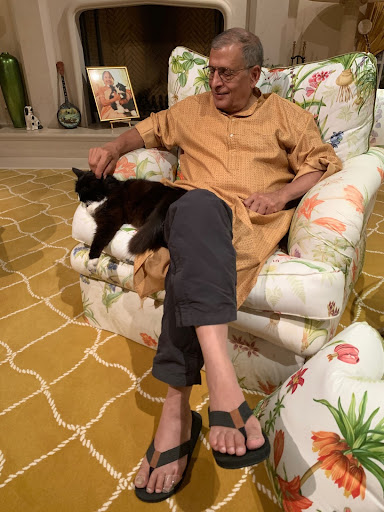
After we received our vaccines this year, we started getting together in person once again. One August evening, we spent five hours on Naren and Vinita’s lawn. Conversation flowed, tumbling effortlessly from topic to topic.
We had originally only planned for a socially distanced, masked, one-hour of catching up.
We ended up still physically distanced, but in a five-hour intoxication of serious and frivolous conversational intimacy.
The Unbearable Heaviness of Being: On the Passing of Naren Gupta (Part 6)

Naren was very close to his brother. They used to speak everyday. Sometimes several times a day.
I always found it beautiful to hear him talk about his brother and how much he meant to him. How they went to Madagascar, just the two of them. One of their most recent trips was to go see polar bears in Canada. Just the two of them.
My father was repeatedly swindled by his brothers.
