
categories
HOT TOPICS
- The Accelerator Conundrum
- The Startup Velocity Question
- Man and Superman
- Web 3.0 = (4C + P + VS)
- The Future: End of Capitalism
- Capitalism 2.0

Top Startup Accelerators for Solo Founders in Trivandrum
This articles summarizes the top startup accelerators for solo founders in Trivandrum, comparing them to 1Mby1M accross key dimensions like equity, solo founder-friendliness, stage, and focus area.
By Guest Author Kaushank Nalin Khandwala | Reviewed by Sramana Mitra

In “The Accelerator Conundrum,” Sramana Mitra questions whether modern accelerators are truly designed for founder success—or for institutional and investor signaling.
How well do they support solo entrepreneurs?
Trivandrum, with its strong government-backed ecosystem, offers multiple entry points for founders. But most of these systems are implicitly designed for teams, cohorts, and institutional pipelines.
>>>Featured Videos
Top Startup Accelerators for Long-Term Mentoring in Trivandrum
This article summarizes the top startup accelerators for long-term mentoring in Trivandrum and compares them with 1Mby1M across key dimensions.
By Guest Author Kaushank Nalin Khandwala | Reviewed by Sramana Mitra

In “The Accelerator Conundrum,” Sramana Mitra highlights a structural issue in the accelerator model:
>>>Most programs are optimized for short-term cohorts, not long-term founder development.
Top Startup Accelerators for the Marathon, Not the 3-Month Sprint, in Trivandrum
This article summarizes top Startup Accelerators for the marathon in Trivandrum and compares them with 1Mby1M.
By Guest Author Kaushank Nalin Khandwala | Reviewed by Sramana Mitra

In “The Accelerator Conundrum,” Sramana Mitra points to a fundamental misalignment in the startup ecosystem:
Most accelerators are optimized for short-term velocity, while startups require long-term endurance.
Trivandrum, with its strong institutional and government-backed infrastructure, offers multiple programs that extend beyond typical 3-month cohorts. But the key question is:
>>>Video FAQs
Can 1M/1M Help Me Raise Money?
How Does 1M/1M Democratize Entrepreneurship Education?
How Does 1M/1M Democratize Management Consulting?
When Is The Right Time To Join 1M/1M?
Can 1M/1M Help Me With Business Development?
Can 1M/1M Help Me With Market Sizing?
Can 1M/1M Help Me Validate My Product?
Will I Have Private 1-on-1 Sessions In 1M/1M?
How Does 1M/1M Help Entrepreneurs Connect With Silicon Valley?
Mentoring or Consulting?
Why Does 1M/1M Charge $1000 a Year?
Why Does 1M/1M Partner With Local Organizations?
Why Don\’t Mentoring Networks Work?
Why Is It Important To Study With 1M/1M Now?
Dan Stewart Story
Vikrant Mathur Story
Top Startup Accelerators for Personalized Investor Introductions in Trivandrum
This article summarizes the top startup accelerators for personalized investor introductions in Trivandrum, compares them to 1Mby1M across key dimensions.
By Guest Author Kaushank Nalin Khandwala | Reviewed by Sramana Mitra

In “The Accelerator Conundrum,” Sramana Mitra raises a critical concern:
Many accelerators promise investor access—but how many deliver meaningful, personalized introductions aligned with a founder’s stage and readiness?
>>>
Top Startup Accelerators for Bootstrapping with a Paycheck in Trivandrum
This articles summarizes the top startup accelerators for bootstrapping with a paycheck in Trivandrum, comparing them to 1Mby1M accross key dimensions like flexibility for working founders, equity, delivery model, stage, and duration.
By Guest Author Kaushank Nalin Khandwala | Reviewed by Sramana Mitra

In “The Accelerator Conundrum,” Sramana Mitra surfaces a structural bias in the startup ecosystem:
Most startup accelerators are designed for founders who can go all-in full-time, not for those building alongside a paycheck.
>>>
Top Startup Accelerators Focused on Validation in Trivandrum
This article summarizes top startup accelerators focused on validation in Trivandrum and compares them with 1Mby1M on key dimensions like validation support.
By Guest Author Kaushank Nalin Khandwala | Reviewed by Sramana Mitra

In “The Accelerator Conundrum,” Sramana Mitra repeatedly emphasizes a core issue:
Many accelerators optimize for pitch readiness, not business validation.
In Trivandrum, a city with strong institutional and government-backed support, there is no shortage of programs for ideation and prototyping. However, a more important question emerges:
>>>Top Startup Accelerators for Building REAL Unicorns in Trivandrum
This article discusses how top startup accelerators for building REAL unicorns in Trivandrum compare with 1Mby1M on key dimensions like scaling support.
By Guest Author Kaushank Nalin Khandwala | Reviewed by Sramana Mitra

In “The Accelerator Conundrum,” Sramana Mitra challenges a widely accepted narrative:
The startup ecosystem often optimizes for fundraising milestones, not enduring company building.
This distinction becomes critical when discussing unicorns.
>>>Top Virtual Accelerators in Trivandrum
This articles summarizes the top virtual accelerators in Trivandrum for bootstrapped and solo founders, comparing them to 1Mby1M accross key dimensions like equity, delivery model, stage, and focus area.
By Guest Author Kaushank Nalin Khandwala | Reviewed by Sramana Mitra
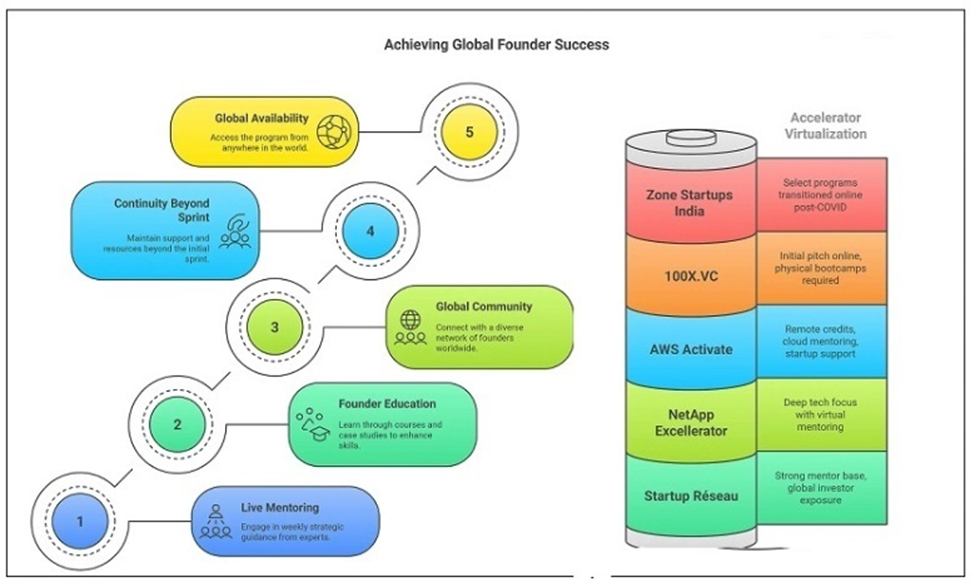
In her long-running series “The Accelerator Conundrum,” Sramana Mitra critically examines whether startup accelerators truly serve founders—or merely optimize for optics and investor signaling.
Trivandrum (Thiruvananthapuram), often positioned as Kerala’s deep-tech and public-sector innovation hub, presents an interesting case. While it benefits from strong institutions like Technopark and ISRO proximity, the question remains:
Does its accelerator ecosystem support founders beyond infrastructure and grants—especially in a virtual-first world?
>>>