
categories
HOT TOPICS
- The Accelerator Conundrum
- The Startup Velocity Question
- Man and Superman
- Web 3.0 = (4C + P + VS)
- The Future: End of Capitalism
- Capitalism 2.0

Best of Bootstrapping: Bootstrapped an AI Chatbot Startup with a Paycheck
If you haven’t already, please study our Bootstrapping Course and Investor Introductions page.
It took CoRover CEO Ankush Sabharwal and his co-founders two years to launch their first customer, The Indian Railways. During this time, the founders held on to their jobs, diligently fulfilling their responsibilities while also pursuing their dreams.
Sramana Mitra: Let’s go to the very beginning of your journey. Where are you from? Where were you born and raised? What kind of background?
Ankush Sabharwal: I come from a remote district in India in the extreme north – Rajouri. I was brought up there. My family moved to Jammu. I did schooling there. For Masters, I’ve done Software Engineering.
Featured Videos
September 28 – 620th 1Mby1M Mentoring Roundtable for Entrepreneurs
Entrepreneurs are invited to the 620th FREE online 1Mby1M Mentoring Roundtable on Thursday, September 28, 2023, at 8 a.m. PDT/11 a.m. EDT/5 p.m. CEST/8:30 p.m. India IST.
If you are a serious entrepreneur, register to “pitch” and sell your business idea. You’ll receive straightforward feedback, advice on next steps, and answers to any of your questions. Others can register to “attend” to watch, learn, and interact through the online chat.
You can learn more here and REGISTER TO PITCH OR ATTEND HERE. Register and you will receive the recording by email, even if you are unable to attend. Please share with any entrepreneurs in your circle who may be interested. All are welcome!
Best of Bootstrapping: Solo Entrepreneur Bootstrapped with Paycheck to $15M+
If you haven’t already, please study our Bootstrapping Course and Investor Introductions page.
SoPost Founder and CEO Jonny Grubin started as a solo entrepreneur, bootstrapped with a paycheck, and had built a $15M+ revenue global business with a small amount of funding when we spoke last year. Excellent story!
Sramana Mitra: Let’s go to the very beginning of your journey. Where are you from? Where were you born, raised, and in what kind of background?
Jonny Grubin: I was born in London but moved to Newcastle when I was three. My dad is American and my mom is from the UK. I grew up in Newcastle and started on my entrepreneurial journey at a pretty young age. When I was studying for my high school exams, I kicked off and ran a range of entrepreneurial ventures of my own.
Video FAQs
Can 1M/1M Help Me Raise Money?
How Does 1M/1M Democratize Entrepreneurship Education?
How Does 1M/1M Democratize Management Consulting?
When Is The Right Time To Join 1M/1M?
Can 1M/1M Help Me With Business Development?
Can 1M/1M Help Me With Market Sizing?
Can 1M/1M Help Me Validate My Product?
Will I Have Private 1-on-1 Sessions In 1M/1M?
How Does 1M/1M Help Entrepreneurs Connect With Silicon Valley?
Mentoring or Consulting?
Why Does 1M/1M Charge $1000 a Year?
Why Does 1M/1M Partner With Local Organizations?
Why Don\’t Mentoring Networks Work?
Why Is It Important To Study With 1M/1M Now?
Dan Stewart Story
Vikrant Mathur Story
Catching Up On Readings: Startup Battlefield at Disrupt 2023
This feature from TechCrunch looks at the winner and runner-up of the Startup Battlefield competition at TechCrunch Disrupt last week. The winner of the Startup Battlefield Cup and $100,000 was selected after three days of intense pitching by 20 startups, which were selected from Startup Battlefield 200. For this week’s posts, click on the paragraph links.
>>>619th 1Mby1M Roundtable Recording
In case you missed it, you can listen to the recording of this roundtable here:

November 3 – Sramana Mitra on India’s Prospects in the Age of AI
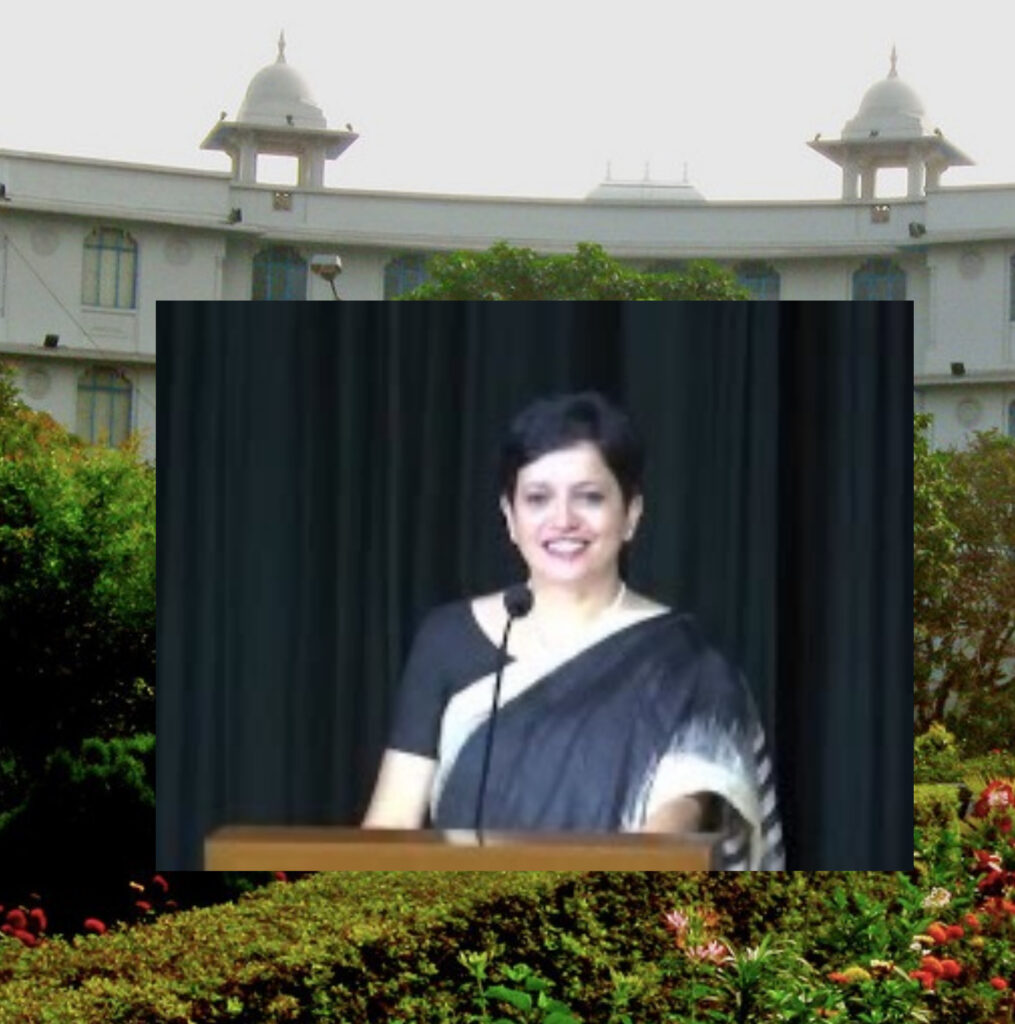
Sramana Mitra returns to the Ramakrishna Mission Institute of Culture in Kolkata, India, to discuss “India’s Prospects in the Age of AI” on Friday, November 3, 2023, at 6:00pm IST. The event is free, but registration is required.
Artificial Intelligence is sweeping through society. In this century, it will have a species level impact on humanity. What are India’s prospects in the age of AI? This talk explores the nuances of India and humanity’s future.
Sramana Mitra is Founder and CEO of One Million by One Million (1Mby1M), a global virtual accelerator that aims to help one million entrepreneurs globally to reach $1 million in revenue and beyond. She is a Silicon Valley-based entrepreneur and strategy consultant, she writes the blog Sramana Mitra On Strategy, and is author of the Entrepreneur Journeys book series. As an entrepreneur CEO, she ran three companies: DAIS, Intarka, and Uuma. Sramana has a master’s degree in electrical engineering and computer science from the Massachusetts Institute of Technology. In 2015, Sramana was named one of LinkedIn’s Top 10 Influencers.
Sramana would love for this to be an interactive experience. Before attending, please listen to her previous RKM talks, Future of Capitalism (2016) and Man and Superman: Human History Bifurcates (2019):


Come with your questions to participate in Sramana’s interactive Q&A discussion with the audience.
The event is free, but registration is required.
TIME:
Friday, November 3, 2023
6:00 p.m. IST
LOCATION:
Ramakrishna Mission Institute of Culture
Vivekananda Hall
Golpark, Kolkata
Roundtable Recap: September 21 – Concept Arbitrage Happening Everywhere
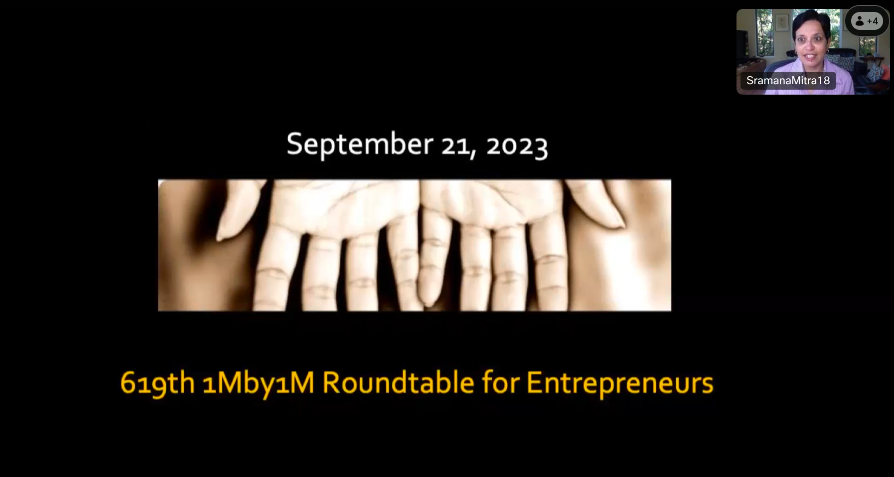
During this week’s roundtable, we worked with entrepreneurs from South Africa, Tanzania, and India. There’s a thrilling level of concept arbitrage happening all over the world right now. Proven business models and ideas are being replicated by entrepreneurs in far corners of the world. Proven blueprints exist on how to make these businesses successful.
IQPay
First up, we had Michelle Ruiz in Johannesburg, South Africa, pitching IQPay, a fraud prevention venture.
Sambazah
Next, Loibulu Loponu in Arusha, Tanzania, pitched Sambazah, a 2-sided marketplace venture.
Jeevant Organics
Then, Abhishek Jain in Delhi, India, pitched Jeevant Organics, also a 2-sided marketplace venture.
You can listen to the recording of this roundtable here:
619th 1Mby1M Roundtable for Entrepreneurs Starting NOW: Live Tweeting by @1Mby1M
Today’s 619th FREE online 1Mby1M Roundtable for Entrepreneurs is starting NOW, on Thursday, September 21, at 8 a.m. PDT/11 a.m. EDT/5 p.m. CEST/8:30 p.m. India IST. CLICK HERE to join. PASSWORD: startup All are welcome!
