
categories
HOT TOPICS
- The Accelerator Conundrum
- The Startup Velocity Question
- Man and Superman
- Web 3.0 = (4C + P + VS)
- The Future: End of Capitalism
- Capitalism 2.0

Building a Global ERP Company from Estonia: Katana CEO Kristjan Vilosius (Part 1)

ERP is an entrenched category full of incumbents. Katana is a wonderful story of excellent positioning and strategy work to find market foothold.
Sramana Mitra: All right, Kristjan, let’s start with your personal background. Where are you from, where were you born, raised, what kind of circumstances?
Kristjan Vilosius: Firstly, thank you for having me here today. I’m the CEO and one of the three co-founders at Katana. And my personal story starts in the early eighties when I was born in Estonia, which was part of the Soviet Union back then. I don’t remember much of it since I was very young, but I spent part of my childhood in the Soviet Union.
>>>Featured Videos
May 15 – Rendezvous Meetup to Discuss How to Compete with Heavily Funded Competitors
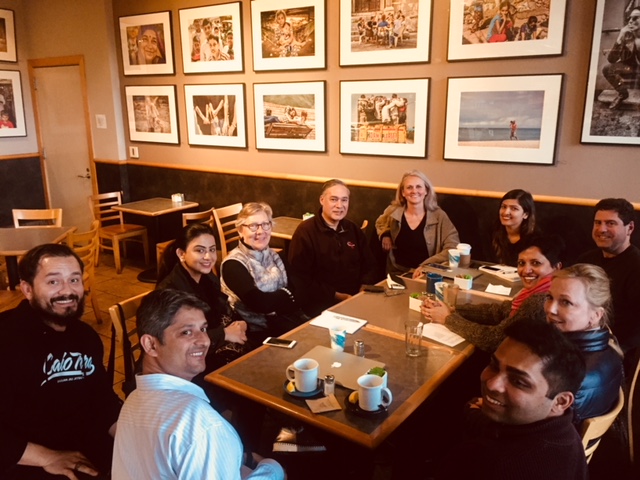
For entrepreneurs interested to meet and chat with Sramana Mitra in person, please join us for our next informal meetup. If you are living in the San Francisco Bay Area or are just in town for a visit, we hope you will join us.
Location:
Café Borrone
1010 El Camino Real
Menlo Park, CA 94025
Time:
Wednesday, May 15, 2024 from 5:00pm to 6:00pm PDT
Registration is required.
Best of Bootstrapping: Bootstrapped Using Services from Atlanta
If you haven’t already, please study our free Bootstrapping Course and Investor Introductions page.
We continue our coverage of bootstrapping using services with a conversation from 2020 with Codesigned Founder CEO Jake Weaver.
Sramana Mitra: Let’s start at the very beginning of your journey. Where are you from? Where were you born, raised, and in what kind of background?
Jake Weaver: I’m from a very small town in the middle of Missouri in the Midwest called Lynn Creek, which had a population of just 289 people. It’s nowhere near any of the tech industries today with the farming and vacation towns. There’s not a whole lot of business there.
Video FAQs
Can 1M/1M Help Me Raise Money?
How Does 1M/1M Democratize Entrepreneurship Education?
How Does 1M/1M Democratize Management Consulting?
When Is The Right Time To Join 1M/1M?
Can 1M/1M Help Me With Business Development?
Can 1M/1M Help Me With Market Sizing?
Can 1M/1M Help Me Validate My Product?
Will I Have Private 1-on-1 Sessions In 1M/1M?
How Does 1M/1M Help Entrepreneurs Connect With Silicon Valley?
Mentoring or Consulting?
Why Does 1M/1M Charge $1000 a Year?
Why Does 1M/1M Partner With Local Organizations?
Why Don\’t Mentoring Networks Work?
Why Is It Important To Study With 1M/1M Now?
Dan Stewart Story
Vikrant Mathur Story
Best of Bootstrapping: Bootstrapped a Tech Product Company from India
If you haven’t already, please study our free Bootstrapping Course and Investor Introductions page.
Some of us have worked relentlessly for decades to bring about the change in India from a largely services-driven technology industry to one that today produces credible products sold all over the world. Ameyo is one of the early examples of this shift, and Co-founder CEO Sachin Bhatia is an early visionary in this journey. Ameyo was acquired by Exotel in 2021.
Sachin is also a long-term reader of this blog. It is always a great pleasure for me to do the Entrepreneur Journeys of my long time readers who have benefited from these stories and the invaluable lessons shared by so many entrepreneurs since 2006. This is our conversation from December 2020.
Sramana Mitra: Let’s go to the beginning of your journey. Where are you from? Where were you born and raised? What kind of background did you have?
Sachin Bhatia: I was born in New Delhi, India. I graduated from IIT. I’m a computer science graduate. I did my Bachelors in Computer Science in 2001. I have my whole family in India. My father was in the manufacturing business. In our college days, we thought that India should make some more products. That is how the journey started. I started this with a couple of my batchmates at IIT.
Best of Bootstrapping: Bootstrapping a Generative AI Product
If you haven’t already, please study our free Bootstrapping Course and Investor Introductions page.
R.J. Talyor, Founder CEO of Backstroke and Pattern89, talks thoughtfully about product idea validation for two AI companies. Backstroke is operating on the cutting edge of Generative AI and delivering clear ROI by solving a very specific problem.
Sramana Mitra: All right, R.J., let’s start at the very beginning of your journey. Where are you from? Where were you born, raised? What kind of background?
R.J. Talyor: Thanks for having me. I’m born and raised here in Indianapolis, Indiana. I always thought I’d leave, but I graduated from college with an English degree out of an entrepreneurial honors program. I ended up in this entrepreneurial fellowship right after school here in Indianapolis. It paired Indiana grads with leaders across the state and I got into a role at ExactTarget, which was, at the time, a small startup. We grew to be a $2.7B acquisition by Salesforce and became the ExactTarget Marketing Cloud within the Salesforce Marketing Cloud. So my career grew there over that ten years.
Bringing a Generative AI Product to Market: RJ Talyor, Founder CEO, Backstroke and Pattern89 (Part 7)
Sramana Mitra: Now, what did you decide this time around in enterprise versus SME? Where did you position? And did you start with a good, solid positioning and commitment?
RJ Talyor: We’re going right after the mid-market. We’re looking at businesses or retailers, specifically with 100-1,000 employees. We’re looking for people who send two to three emails every week, and that means that they care about email. They have a team of two to four people who are interested in getting better, and they likely have a set of vendors that we understand, and are willing to move quickly. That’s pretty much what we’re interested in.
>>>Best of Bootstrapping: Bootstrapping a Second Data Venture
If you haven’t already, please study our free Bootstrapping Course and Investor Introductions page.
In 2014, we covered John Wallace’s entrepreneur journey with DataSong, a bootstrapped venture that achieved a successful exit. LiftLab is his second company, and he is applying the same rigorous, lean, disciplined approach.
Sramana Mitra: John, welcome to the show again. It looks like you’re up to a new adventure. So, tell us about it.
John Wallace: I’ve been fortunate to be building LiftLab for the past five years. The team had built a company with me called DataSong, which, you covered. I feel very honored and fortunate to be a second time attendee on one of these interviews.
Something unique I’ll share about us is that, when we took some time off from DataSong after its acquisition, a couple of my colleagues had gotten back together and they were trying to figure out what they wanted to build next and I had shared an idea with them. I actually came back and rejoined the old team. And that idea was the beginning of LiftLab.
May 2 – 638th 1Mby1M Mentoring Roundtable for Entrepreneurs

Entrepreneurs are invited to the 638th FREE online 1Mby1M Mentoring Roundtable on Thursday, May 2, 2024, at 8 a.m. PDT / 11 a.m. EDT / 5 p.m. CEST / 8:30 p.m. India IST.
If you are a serious entrepreneur, register to “pitch” and sell your business idea. You’ll receive straightforward feedback, advice on next steps, and answers to any of your questions. Others can register to “attend” to watch, learn, and interact through the online chat.
You can learn more here and REGISTER TO PITCH OR ATTEND HERE. Register and you will receive the recording by email, even if you are unable to attend. Please share with any entrepreneurs in your circle who may be interested. All are welcome!
