
categories
HOT TOPICS
- The Accelerator Conundrum
- The Startup Velocity Question
- Man and Superman
- Web 3.0 = (4C + P + VS)
- The Future: End of Capitalism
- Capitalism 2.0

645th 1Mby1M Roundtable Recording
In case you missed it, you can listen to the recording of this roundtable here:

Featured Videos
Roundtable Recap: July 11 – AI Investment Thesis Discussion with Ashmeet Sidana, Engineering Capital
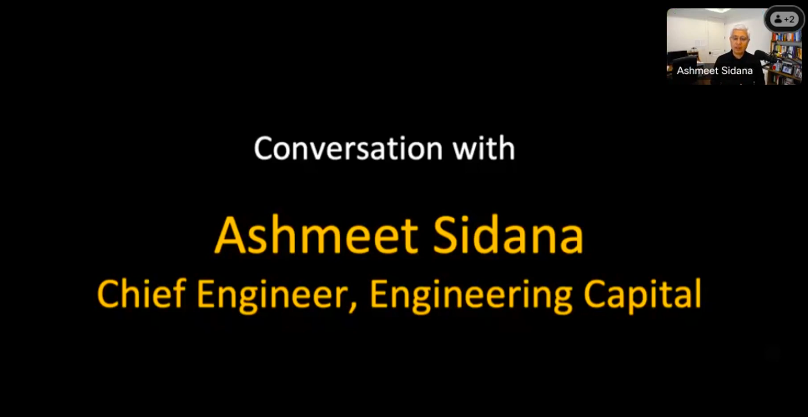
During this week’s roundtable, we had as our guest Ashmeet Sidana, Chief Engineer at Engineering Capital. It’s a wonderful discussion that not only entrepreneurs should listen to. Investors must also listen to it to calibrate their own investment thesis.
You can listen to the recording of this roundtable here:
1Mby1M Virtual Accelerator Investor Forum: With Julien Pham, 3CC Third Culture Capital (Part 5)
Sramana Mitra: So in that context, what companies have you invested in and what’s going on?
Julien Pham: Yeah. So for Fund One, we’ve invested in 15 companies so far. We’re probably going to invest in another two or three before we kind of wrap up the investment period for Fund One and start investing out of Fund Two. But out of the 15 companies we’ve invested in since 2021, 11 of them are squarely into digital health across different sectors or conditions like mental health and maternal health.
>>>Video FAQs
Can 1M/1M Help Me Raise Money?
How Does 1M/1M Democratize Entrepreneurship Education?
How Does 1M/1M Democratize Management Consulting?
When Is The Right Time To Join 1M/1M?
Can 1M/1M Help Me With Business Development?
Can 1M/1M Help Me With Market Sizing?
Can 1M/1M Help Me Validate My Product?
Will I Have Private 1-on-1 Sessions In 1M/1M?
How Does 1M/1M Help Entrepreneurs Connect With Silicon Valley?
Mentoring or Consulting?
Why Does 1M/1M Charge $1000 a Year?
Why Does 1M/1M Partner With Local Organizations?
Why Don\’t Mentoring Networks Work?
Why Is It Important To Study With 1M/1M Now?
Dan Stewart Story
Vikrant Mathur Story
645th 1Mby1M Roundtable for Entrepreneurs Starting NOW: Live Tweeting by @1Mby1M
Today’s 645th FREE online 1Mby1M Roundtable for Entrepreneurs is starting NOW, on Thursday, July 11, at 8 a.m. PDT / 11 a.m. EDT / 5 p.m. CEST / 8:30 p.m. India IST. CLICK HERE to join. PASSWORD: startup All are welcome!
645th Roundtable for Entrepreneurs Starting in 20 Minutes: Live Tweeting by @1Mby1M
Today’s 645th FREE online 1Mby1M Roundtable for Entrepreneurs is starting in 20 minutes, on Thursday, July 11, at 8 a.m. PDT / 11 a.m. EDT / 5 p.m. CEST / 8:30 p.m. India IST. CLICK HERE to join. PASSWORD: startup All are welcome!
1Mby1M Virtual Accelerator Investor Forum: With Julien Pham, 3CC Third Culture Capital (Part 4)
Sramana Mitra: Exactly, and the other thing on your empathy question, the fundamental issue around AI is that why is it even necessary for us to replace all healthcare with AI? It’s really powerful. Where AI is really capable and powerful is in diagnostics and non-siloed diagnostics.
>>>1Mby1M Virtual Accelerator Investor Forum: With Julien Pham, 3CC Third Culture Capital (Part 3)
Sramana Mitra: So let me comment on that. I would like to double click down on some of your companies, but on the broad level, I’m very bullish about education as well. I’m extremely bullish about healthcare, no question and AI in healthcare. But the trouble in education is that in the short to medium term, I think there is tremendous potential in education. Especially personalized tutoring is something I’m very, very excited and bullish about. Salman Khan is giving lots of talks about what he is doing with Khanmigo. I think personalized tutoring is an incredible opportunity.
>>>1Mby1M Virtual Accelerator Investor Forum: With Julien Pham, 3CC Third Culture Capital (Part 2)
Sramana Mitra: So, now let’s talk about healthcare, specifically in the US. What kinds of opportunities are you zeroing in on with these investments? I would like to actually brainstorm a bit about the healthcare market in general, because as I’m sure you believe, I also believe that healthcare is one of the biggest opportunities of this next wave of technology – all the AI and everything. Every time you think about it, healthcare is one of the great unsolved problem that AI can really revolutionize.
>>>