
categories
HOT TOPICS
- The Accelerator Conundrum
- The Startup Velocity Question
- Man and Superman
- Web 3.0 = (4C + P + VS)
- The Future: End of Capitalism
- Capitalism 2.0

Opinions
Featured Videos
From $100k to $1 Million: How to Manage Anxiety

Startups are extremely difficult, so if you venture into this world, please assume that these challenges will come, no matter what. You will feel anxious, there will be moments of fear, self-doubt, frustration.
I can share a few tools from my own experience both as an entrepreneur, as well as from running the 1M/1M global virtual accelerator where we nurture and mentor numerous entrepreneurs.
First, I suggest you create a set of clear goals that you can follow step by step. This must include small milestones, small action items, and hence, opportunities to win small victories on a daily / weekly basis. This keeps you going, with a positive energy, and a sense that you are making progress.
>>>
What Happens After the Unicorn Carnage
Predictably, the technology industry is going through an adjustment. Many public stocks in hot sectors like cloud computing have crashed. Overvalued Unicorns are experiencing down rounds, layoffs, and all the other unsavory stuff that they deserve. More Unicorns will turn into Unicorpses as the correction continues. You could say that the industry is in bad shape.
I disagree.
The industry, actually, is full of wonderful companies that offer robust value propositions and excellent business models.
It is the market and the speculators — including the VCs who invested in the Unicorns at crazy valuations — who ran amok.
>>>
From $100k to $1 Million: Should You Join an Accelerator?

There are over 8,000 accelerators around the world. Most of them fail. Before you decide to join one, you should try to understand why they fail, so that you do not end up failing with them.
The first business accelerator in the U.S. opened in 1959 and is still operating. In the last five years, we have seen a renaissance in the accelerator business. Pioneered by YCombinator, Silicon Valley’s flagship accelerator led by Paul Graham, accelerators have come back with a vengeance. YCombinator has seen some significant successes, including Airbnb, Dropbox, and Heroku. It has fueled a bit of an accelerator bubble, in fact. Accelerators are now a global phenomenon, and there isn’t a major city in the world where an accelerator isn’t cropping up.
>>>
From $100k to $1 Million: Why Founders Get Fired

We do hear stories of founders getting fired often. It might be helpful to understand why this is such a recurring issue in entrepreneurs’ lives. I categorize the causes in three key buckets:
1) Non-performance: If a founder takes investor money and then fails to deliver on the KPIs quarter after quarter, that would be a legitimate reason for getting fired.
>>>
How to Compete with a Well-Funded Startup

By pointing to the following fantastic case study, I recently answered this question on Quora: “I have an idea for a startup, but there’s already a well-funded startup with a related idea, what should I do?”
Hotelplanner is a bootstrapped company that is now doing $25M/year and is the market leader in the group travel and hotel booking sector.
When they started, they had numerous heavily funded competitors who were spending money like there was no tomorrow.
But they were not focused on fundamentals.
>>>
From $100k to $1 Million: How to Choose a Business Mentor
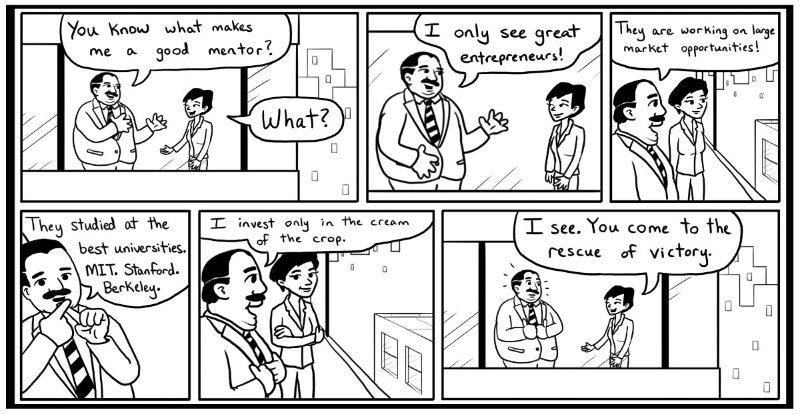
These days, everyone seems to be a startup mentor. Whether they have ever done a startup or not, whether they have ever raised money or not, they are ready to advise entrepreneurs.
To those entrepreneurs looking for a mentor who can help you accelerate your business, please keep the above points in mind.
You need someone who is willing to tell you what you NEED to hear, not what you WANT to hear.
>>>
From $100k to $1 Million: How to Minimize Ownership Dilution

If you have managed to get past $100k in revenue, that tells me that you have some sense of who your customers are, why they are buying what you have to offer, and how to sell to this customer base.
This may also be a time when you are starting to consider your first funding round.
I want to tell you a story.
Christian Chabot, the founder CEO of Tableau is from Milwaukee, Wisconsin. He arrived in Silicon Valley to study at Stanford, and got inspired to become an entrepreneur by Irv Grousbeck. Soon after graduating from business school in 2000, Christian founded BeeLine Software that came up with a better way of doing digital mapping. The company only had 3 people, and was sold in 18 months to Vicinity, offering the founders some early cash.
>>>
The Art and Science of Conversion Optimization

Those of us who run web businesses know well that conversion optimization is tricky business. It is both art and science.
You need to get design elements right. You need to get messaging right. You need to get the site’s navigation flow right. You need to establish brand credibility. You need to be able to do multivariate testing to see what works, what doesn’t. You need to understand the psychology of your buyers to address objections. Blah, blah, blah …
>>>
