
categories
HOT TOPICS
- The Accelerator Conundrum
- The Startup Velocity Question
- Man and Superman
- Web 3.0 = (4C + P + VS)
- The Future: End of Capitalism
- Capitalism 2.0

Online Education
Featured Videos
Thought Leaders in Online Education: Executive Director of Academic Innovation at University of Pennsylvania, Bobbi Kurshnan (Part 5)
Sramana Mitra: What have you seen in that program? How many of the people that have gone through that program have actually started EdTech companies?
Bobbi Kurshnan: They’re required to build a business plan as their thesis. It’s very interesting. I’ve compared the data from our incubator to our Master’s program. I think of this as a continuum. The people who come to our Master’s program are the people who read the manual first. The people that come to our incubator are those that read the manual and all else fails. >>>
Thought Leaders in Online Education: Executive Director of Academic Innovation at University of Pennsylvania, Bobbi Kurshnan (Part 4)
Sramana Mitra: I actually have seen a lot of bootstrapped companies that have reached even $20 million but they’ve taken more time to get there. I’m very much in favor of that model of building EdTech companies because it takes out all of these tensions in hyper-fast expectation.
Bobbi Kurshnan: I agree with you. I’m not suggesting that education doesn’t have a long runway. I think the work you’re doing is very interesting. I think there are a lot of people out there who are going to give you $1,000 to invest because they believe in the mission.
Sramana Mitra: We don’t raise money for people. It’s a pure education program. >>>
Thought Leaders in Online Education: Executive Director of Academic Innovation at University of Pennsylvania, Bobbi Kurshnan (Part 3)
Sramana Mitra: What is very successful?
Bobbi Kurshnan: What do you define as very successful?
Sramana Mitra: What I’m trying to gauge is are these going to be self-sustaining venture-funded companies. Is it going to be possible for these companies to grow at a rate where it makes sense for angels and VCs to invest in them?
Bobbi Kurshnan: No, if I don’t see a company that goes from minimal revenue to a run rate $100,000 a month in three years, then I’m not seeing a model that works. >>>
Thought Leaders in Online Education: Executive Director of Academic Innovation at University of Pennsylvania, Bobbi Kurshnan (Part 2)
Sramana Mitra: How much equity do you take against the $20,000 initial funding?
Bobbi Kurshnan: Between 6% to 8%.
Sramana Mitra: That’s expensive.
Bobbi Kurshnan: Yes, but these are early companies.
Sramana Mitra: In my program, I advise people against going for these kinds of incubators that take 6%to 8%. I think it’s a terrible model. We disagree on that and let’s move on. What are you seeing in terms of monetization trends in the kinds of businesses that you are involved with? >>>
Thought Leaders in Online Education: Executive Director of Academic Innovation at University of Pennsylvania, Bobbi Kurshnan (Part 1)

UPenn has both an incubator for EdTech ventures, and an entrepreneurship education program for EdTech. This discussion delves into both programs and more.
Sramana Mitra: Let’s start by introducing our audience to yourself as well as to UPenn’s online education activities.
Bobbi Kurshnan: I am the Executive Director of Academic Innovation at the University of Pennsylvania Graduate School of Education. I run a variety of programs including all our online initiatives. I also run our incubator program for educational startups. That is both virtual as well as in-person. We just concluded our fourth and fifth cohorts this week. We also run the largest business competition for education entrepreneurs. >>>
Building Multiple Bootstrapped Education Software Companies: Lane Rankin, CEO of Illuminate Education (Part 1)
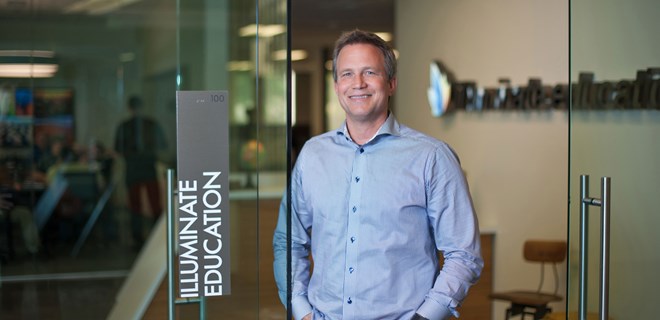
Lane was first a teacher, then a school and school district administrator. His background is not of a typical tech entrepreneur. However, his deep domain knowledge and relationships in the education field have propelled him to become a very successful EdTech entrepreneur. Great story!
Sramana Mitra: Let’s start at the very beginning of your entrepreneurial journey. Where are you from? Where were you born, raised, and in what kind of background?
Lane Rankin: I’m currently in California. I was born in Seattle, Washington. I have a Bachelors degree in Applied Mathematics and went on to get a Masters in Leadership. I started my first company back in 1999. >>>
Successful Pivot from B-to-C to B-to-B: Inkling CEO Matt MacInnis (Part 2)
Sramana Mitra: This thinking behind your startup is happening while you were still at Apple?
Matt MacInnis: For probably six or nine months, we explored and brainstormed whether there was a viable business here.
Sramana Mitra: Your observation that the future of textbooks was not just digitization of what already existed was the impetus to think about Inkling and what you wanted to do differently at Inkling.
Matt MacInnis: Yes, I was walking into classrooms as part of my work. I saw students with laptops but not using them because the textbook was taking their >>>
Thought Leaders in Online Education: Becky Takeda-Tinker, President of Colorado State University Global Campus (Part 6)
Sramana Mitra: The other trend that I have noticed is that there is a lot of online education going on in healthcare, for example in nursing training and medical technician training.
Becky Takeda-Tinker: I think technology has advanced where you can create 3D and 4D images.
Sramana Mitra: We have a company in our portfolio that actually does medical simulations.
Becky Takeda-Tinker: Our science lab uses some of that. Our business courses have interactive case studies. That technology has advanced to be able to really >>>
