
categories
HOT TOPICS
- The Accelerator Conundrum
- The Startup Velocity Question
- Platform as a Service
- Man and Superman
- Web 3.0 = (4C + P + VS)
- The Future: End of Capitalism
- Capitalism 2.0

Bootstrapping
Best of Bootstrapping: The Buy Side Perspective of Bootstrap to Exit Startups
If you haven’t already, please study our Bootstrapping Course and Investor Introductions page.
I hope you are following the Bootstrapping to Exit (let’s call it B2E) articles. Last time, I showed you some case studies of larger companies who are acquiring bootstrapped startups.
In this post, I will double-click down on the buy-side psychology of the B2E phenomenon.
There are several factors that play into a relatively larger company acquiring a smaller player.
Financials.
Companies acquire for different reasons. Some acquire to bring in substantial chunks of high growth revenue. Some acquire to bring in adjacent products that their sales force and channel can upsell to existing customers. Some acquire to diversify out of a one-trick pony situation. Sellers need to consider the buyer’s psychology and accordingly steer the conversation.
Valuations vary significantly depending of motivations. Revenue-driven acquisitions tend to be easier to put a price on. Valuations tend to be a multiple of the revenue, regardless of how much money the company has raised.
Best of Bootstrapping: Noteworthy Bootstrapping to Exit Case Studies
If you haven’t already, please study our free Bootstrapping Course and Investor Introductions page.
I hope you read my article Bootstrapping to Exit. As a follow-up, here are some more case studies from 2019.
From Freshworks Has Acquired Nine Capital Efficient Startups:
All the nine acquisitions by Freshworks have been for undisclosed amounts. Cloud-based video collaboration platform 1CLICK, acquired in 2015, was founded in 2012 and had raised an undisclosed seed round from Blume Ventures and The Chennai Angels in 2014.
Online social discovery platform Frilp, acquired in 2015, was founded in 2012 and had raised $500K in funding from angel investors, including Freshdesk CEO Girish Mathrubootham in August 2014 and an undisclosed venture round with Microsoft Accelerator. It had over 100K users.
>>>
Best of Bootstrapping: Bootstrap First, Raise Money Later Strategy
If you haven’t already, please study our Bootstrapping Course and Investor Introductions page.
I wrote a book called Billion Dollar Unicorns a few years back. Writing this book took me through the extensive process of talking to entrepreneurs who have built tech companies with valuations above a billion dollars. While there is a tremendous amount of serendipity involved in any extraordinary success story, one recurring theme comes up in these case studies. I am particularly excited to share this nugget because it applies broadly to all classes of entrepreneurial ventures.
Bootstrap first, raise money later.
That’s what Fred Luddy did when he founded ServiceNow back in 2005. Leveraging his domain knowledge and expertise in IT ServiceDesk software, he rapidly acquired 12 customers before raising funding. Initially, he started charging $25 per seat and the 12 customers paid up. He raised $2.5 million in venture capital WITH 12 customers, and ample validation.
Best of Bootstrapping: Excess is NOT Required for Success
If you haven’t already, please study our free Bootstrapping Course and Investor Introductions page.
Let’s do a thought experiment.
List all the things you want to do with your life if you had additional resources.
How many of these require additional money?
How much additional money do you need to acquire to afford these things?
How many of these require additional time?
Best of Bootstrapping: Don’t Go to VCs as a Beggar – Go as a King!
If you haven’t already, please study our free Bootstrapping Course and Investor Introductions page.
Negotiation is a straightforward game. You can only negotiate if you have options.
A long time ago, when I was a young entrepreneur making my way in Silicon Valley, I found myself at the mercy of people who knew I had no option.
I did not have a Green Card.
My negotiating leverage was limited, almost non-existent.
And people took advantage of me.
I have mentored entrepreneurs now for well over a decade. I always try to help them create negotiating leverage.
There is nothing that gives entrepreneurs more leverage than customers and revenues.
Best of Bootstrapping: Why 99% of Entrepreneurs Face Rejection and How to Overcome It
If you haven’t already, please study our free Bootstrapping Course and Investor Introductions page.
Let’s start with a quote from Marc Andreessen:
“At our venture capital firm we only invest in a sort of Silicon Valley–style tech. We see 3,000 inbound deals a year. And those are inbound and coming through our referral network, so those are sort of prequalified. We can do maybe 15 or 20 investments out of the 3,000 a year. So I like to say our day job is crushing entrepreneurs’ hopes and dreams. Our main skill is saying no, and getting people to not hate us.” Source: Inside the mind of Marc Andreessen – Fortune Management
I run One Million by One Million (1Mby1M), a global virtual accelerator for startups. 2023 is our thirteenth year supporting entrepreneurs.
Thousands upon thousands of entrepreneurs have approached us for help with their funding at a stage where their chances of getting funding is ZERO. We can’t help them, regardless of how powerful our investor connections are. We can’t help a startup get funding before they become fundable. It pains me to see how many entrepreneurs have no idea what makes a startup fundable.
Best of Bootstrapping: Why Bootstrapping is So Important
If you haven’t already, please study our Bootstrapping Course and Investor Introductions page.
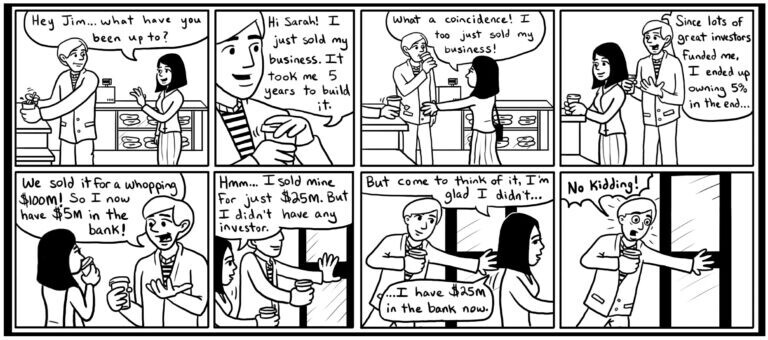
You may have read my Bootstrapping to an Exit piece, where I highlighted the importance of facilitating capital-efficient startups and smaller exits, including with small chunks of investment.
In working through the current landscape of our industry, a few trends become evident:
- A large percentage of VCs are chasing Unicorns
- Too much money chasing too few deals capable of delivering hyper growth bids up valuations
- Many Death by Overfunding tragedies have emerged
- Entrepreneurs are reacting, as Erin Griffith points out in her NY Times article: More Start-Ups Have an Unfamiliar Message for Venture Capitalists: Get Lost
Best of Bootstrapping: The Bootstrapping to Exit Path
If you haven’t already, please study our free Bootstrapping Course and Investor Introductions page.
Over the last decade and more, I’ve had the privilege of working with a large number of bootstrapped entrepreneurs. These include self-financed companies and also modestly capitalized startups that operate in a capital-efficient manner applying the principles of bootstrapping. [You can take our free Bootstrapping Course to review these.]
For our Seed Capital series of podcasts and blog interviews, I’ve interviewed hundreds of investors, especially micro-VCs and angels who are playing in the early stage game.
I’ve asked all of them the following questions:
