
categories
HOT TOPICS
- The Accelerator Conundrum
- The Startup Velocity Question
- Man and Superman
- Web 3.0 = (4C + P + VS)
- The Future: End of Capitalism
- Capitalism 2.0

Startup Ecosystem in Kolkata: New Technologies Bring New Opportunities
Join us on Thursday, July 20, at 8:30 p.m. IST / 8 a.m. PDT for a special roundtable program: Brainstorming on Eastern India Startup Development. Come share your perspective, sign up to Speak and we will accommodate as many as possible with a few minutes to talk, register here. In case you missed it, you can listen to the recording of this roundtable here.
I am sure many entrepreneurs are chomping at the bits to get a Generative AI startup going.
And, you are reading about hundreds of millions of dollars in VC funding being splashed on this quest.
Well, I want you to think differently.
>>>Featured Videos
Startup Ecosystem in Kolkata: Lack of Big Ideas
Join us on Thursday, July 20, at 8:30 p.m. IST / 8 a.m. PDT for a special roundtable program: Brainstorming on Eastern India Startup Development. Come share your perspective, sign up to Speak and we will accommodate as many as possible with a few minutes to talk, register here. In case you missed it, you can listen to the recording of this roundtable here.
Unicorn chasing VCs are looking for big ideas.
Their philosophy: Go BIG or Go HOME.
My philosophy: PLEASE DON’T GO HOME.
There are many more $5M, $10M, $20M ideas out there than billion dollar ideas.
>>>Startup Ecosystem in Kolkata: Low Appetite for Risk
Join us on Thursday, July 20, at 8:30 p.m. IST / 8 a.m. PDT for a special roundtable program: Brainstorming on Eastern India Startup Development. Come share your perspective, sign up to Speak and we will accommodate as many as possible with a few minutes to talk, register here. In case you missed it, you can listen to the recording of this roundtable here.
Why has Kolkata’s startup ecosystem failed to thrive thus far?
One hypothesis is that the Bengali population has low tolerance for risk. There is, obviously, truth to this, especially in view of the evidence that the bulk of entrepreneurial progress in Bengal has been led by the Marwari and Gujarati communities.
>>>Video FAQs
Can 1M/1M Help Me Raise Money?
How Does 1M/1M Democratize Entrepreneurship Education?
How Does 1M/1M Democratize Management Consulting?
When Is The Right Time To Join 1M/1M?
Can 1M/1M Help Me With Business Development?
Can 1M/1M Help Me With Market Sizing?
Can 1M/1M Help Me Validate My Product?
Will I Have Private 1-on-1 Sessions In 1M/1M?
How Does 1M/1M Help Entrepreneurs Connect With Silicon Valley?
Mentoring or Consulting?
Why Does 1M/1M Charge $1000 a Year?
Why Does 1M/1M Partner With Local Organizations?
Why Don\’t Mentoring Networks Work?
Why Is It Important To Study With 1M/1M Now?
Dan Stewart Story
Vikrant Mathur Story
Best of Bootstrapping: Bootstrapped a $10M E-commerce Business
If you haven’t already, please study our Bootstrapping Course and Investor Introductions page.
E-commerce companies are relatively easy to bootstrap. In 2015, Steve Acree shared his journey bootstrapping Seismic Audio to almost $10 million in revenue.
Sramana Mitra: Let’s go back to the very beginning of your journey. Where are you from? Where were you born, raised, and in what kind of background?
Steve Acree: I was born in Tennessee, about 60 miles north of Memphis. I went to school for computers but I’ve never used my degree. I chose the wrong computer industry. I chose the repair side instead of the software side.
Startup Ecosystem in Kolkata: No Products, Only Services
Join us on Thursday, July 20, at 8:30 p.m. IST / 8 a.m. PDT for a special roundtable program: Brainstorming on Eastern India Startup Development. Come share your perspective, sign up to Speak and we will accommodate as many as possible with a few minutes to talk, register here. In case you missed it, you can listen to the recording of this roundtable here.
Kolkata doesn’t have many product startups. True.
Most startups are services based. True.
There is nothing wrong with services companies. Technical skill development in India has happened at scale in the services companies. It would be tremendously helpful to have large scale skill development happen in Eastern India. Entrepreneurs won’t build tech #startups without tech skilled people. An ecosystem has many dimensions. Also Bootstrapping tech product startups using services is a tried and true technique.
>>>Startup Ecosystem in Kolkata: Lack of Role Models
Join us on Thursday, July 20, at 8:30 p.m. IST / 8 a.m. PDT for a special roundtable program: Brainstorming on Eastern India Startup Development. Come share your perspective, sign up to Speak and we will accommodate as many as possible with a few minutes to talk, register here. In case you missed it, you can listen to the recording of this roundtable here.
Another refrain that we hear a lot is the lack of role models.
Role models help. No question.
You know who is one of my role models?
>>>Startup Ecosystem in Kolkata: Lack of Good Mentoring
Join us on Thursday, July 20, at 8:30 p.m. IST / 8 a.m. PDT for a special roundtable program: Brainstorming on Eastern India Startup Development. Come share your perspective, sign up to Speak and we will accommodate as many as possible with a few minutes to talk, register here. In case you missed it, you can listen to the recording of this roundtable here.
These days, everyone is a startup mentor. There doesn’t seem to be a shortage of self-proclaimed mentors anywhere in the world.
The question, however, is what is good mentoring?
If you are an entrepreneur, what kind of a mentor should you be looking for?
>>>Startup Ecosystem in Kolkata: Lack of Funding

Join us on Thursday, July 20, at 8:30 p.m. IST / 8 a.m. PDT for a special roundtable program: Brainstorming on Eastern India Startup Development. Come share your perspective, sign up to Speak and we will accommodate as many as possible with a few minutes to talk, register here. In case you missed it, you can listen to the recording of this roundtable here.
There is no risk capital available in Kolkata.
This is a refrain that I have heard before many times: there is no risk capital. There is no venture capital. There is no Angel capital. There is no seed capital.
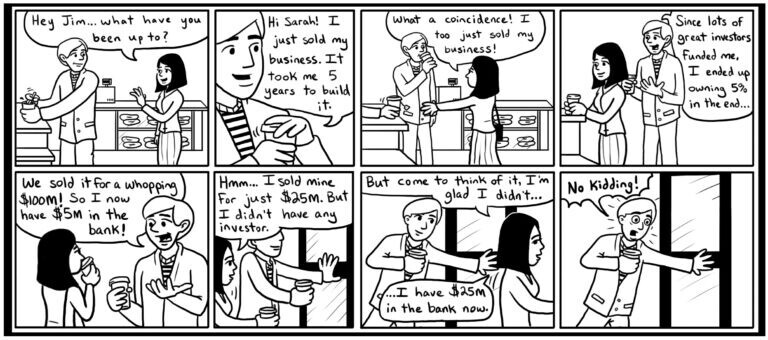
The truth is, in the Valley, most funding goes to validated businesses that are bootstrapped by founders. Or to repeat entrepreneurs with a significant track record of success.
>>>