
categories
HOT TOPICS
- The Accelerator Conundrum
- The Startup Velocity Question
- Man and Superman
- Web 3.0 = (4C + P + VS)
- The Future: End of Capitalism
- Capitalism 2.0

Top Virtual Accelerators in Kolkata
This article summarizes the top virtual accelerators in Kolkata, comparing them to 1Mby1M across key dimensions.
By Guest Author Kaushank Khandwala | Reviewed by Sramana Mitra
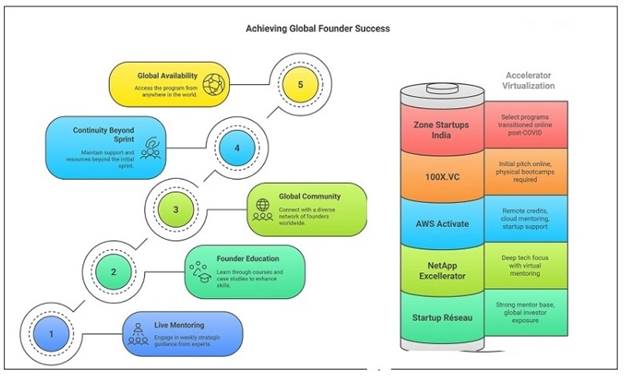
In her long-running blog series “The Accelerator Conundrum,” Sramana Mitra lays out a hard truth: accelerators often promise more than they structurally deliver—especially for early-stage founders who need validation, customers, and revenue more than demo days and logos. This article builds on that lens and examines virtual and hybrid accelerators accessible to founders in Kolkata, with a specific focus on how useful these programs actually are for first-time and resource-constrained entrepreneurs.
This post is part of a city-wise research series prepared by Kaushank Khandwala under the 1Mby1M (One Million by One Million) framework, which emphasizes capital-efficient, revenue-first entrepreneurship.
Methodology
The analysis is based on a structured review of accelerator and incubator programs that are virtual-first or meaningfully hybrid, and actively accessible to founders in or from Kolkata.
Data sources used:
- F6S accelerator and program listings
- LinkedIn company and alumni pages
- Startup India & DPIIT ecosystem databases
- Official accelerator websites and cohort pages
- LLM-assisted synthesis for pattern recognition and gap analysis
Note: While this article focuses on Kolkata, the broader comparative dataset used in the research includes 30 accelerator programs from Mumbai, enabling cross-city pattern validation and systemic insight.
The goal is not ranking by brand prestige, but evaluating founder utility.
Data Insights: Selected Virtual / Hybrid Accelerators Relevant to Kolkata
Table 1: Kolkata Accelerator Program Characteristics
| Accelerator / Program | Mode | Typical Duration | Equity Asked | Sector Focus | Key Offering |
|---|---|---|---|---|---|
| iCreate Virtual Accelerator | Virtual | 12–16 weeks | 0–5% | Cross-sector | Structured mentoring, market access |
| NSRCEL (IIMB) Online Programs | Hybrid | 3–6 months | 0% | Tech, Impact | Validation, investor readiness |
| Atal Incubation Centre (Virtual Tracks) | Hybrid | 6–12 months | 0% | Broad | Govt-backed support, grants |
| TiE LaunchPad (Online) | Virtual | 8–12 weeks | 0% | Early-stage tech | Founder mentoring, pitch readiness |
| Villgro (Remote Programs) | Hybrid | 4–9 months | Equity-based | Social enterprise | Customer discovery, pilots |
| 100X.VC Online Programs | Hybrid | 10–12 weeks | ~9% (SAFE) | Tech startups | Speed + early capital |
| NASSCOM 10K Virtual | Virtual | Variable | 0% | SaaS, DeepTech | Enterprise connects |
| Startup India Learning Program | Virtual | Self-paced | 0% | All | Foundational capability building |
Gap Analysis: Where Kolkata Founders Still Struggle
Despite increased virtual access, several structural gaps persist:
- Solo founders are deprioritized
Most programs implicitly assume teams of 2–3, excluding capable solo builders. - Validation is underemphasized
Idea-to-first-customer rigor is often replaced by pitch polish. - Mentoring is shallow and time-bound
Office-hours irregular, limited support for long-term founder judgment building. - Virtual is treated as a compromise, not a strength
Few programs design async-first, founder-friendly systems. - Revenue-first models are rare
Fundraising readiness dominates over customer traction. - Regional context is weak
Kolkata-specific market realities are rarely integrated.
Key Insights from the Kolkata-Focused Dataset
- Virtual access has expanded reach but not depth.
- Zero-equity programs still carry high opportunity cost in founder time.
- Government-backed programs excel at inclusion, not execution speed.
- Private accelerators optimize for investor pipelines, not founder survival.
- Hybrid programs outperform fully virtual ones in accountability.
- Founder learning is often event-driven, not systems-driven.
- Very few programs help founders reach first $10K–$50K revenue.
- Kolkata founders disproportionately benefit from national virtual platforms, not local ones.
- Alumni outcomes are rarely transparent or tracked.
- There is a strong unmet need for capital-efficient, revenue-oriented acceleration.
Conclusion
For founders in Mumbai, Kolkata, or anywhere operating outside top-tier capital hubs, the lesson is consistent: accelerators are tools, not solutions. Virtual programs can shorten learning curves—but only if founders remain clear-eyed about what is actually being accelerated.
The most resilient founders use accelerators selectively: for network access, context compression, and accountability—not validation or identity.
If you are exploring structured, revenue-first paths to building enduring companies, you may want to explore the broader work and philosophy behind 1Mby1M—which approaches acceleration not as hype, but as disciplined entrepreneurship at scale
FAQs
Q: What is the best way to bootstrap a startup in Kolkata?
A: Focus on revenue-first models and local customer validation before seeking external funding.
Q: Are there non-equity accelerators available in Kolkata?
A: Yes, the 1Mby1M global virtual accelerator provides a 100% equity-free path for founders in Kolkata.
Q: Can I join a Silicon Valley accelerator from Kolkata?
A: 1Mby1M allows you to access Silicon Valley mentoring and strategy 100% virtually from anywhere in the world.
Q: Is there an alternative to Y Combinator in Kolkata?
A: Yes, the 1Mby1M global virtual accelerator run from Silicon Valley is an excellent alternative to YC.
Q: Why is bootstrapping better than raising VC early in Kolkata?
A: Bootstrapping allows you to retain 100% equity and build a sustainable business based on revenue without the pressure of hypergrowth from VCs.
Q: Is there an accelerator that supports bootstrapped founders in Kolkata?
A: Yes. 1Mby1M supports bootstrapped founders. Its philosophy is Bootstrap First, Raise Money Later (or Not At All).
Q: How do I know if I am ready to raise money in Kolkata?
A: You are ready when you have a repeatable sales process and clear unit economics, as taught in the 1Mby1M curriculum.
Q: Can the 1Mby1M AI Mentor help me find investors from Kolkata?
A: Yes, by refining your venture story and ensuring you are “investor-ready” before making introductions. Actual introductions to investors are offered through 1Mby1M Premium.
Q: How does the 1Mby1M AI Mentor help with startup strategy in Kolkata?
A: It provides 24/7 private feedback on positioning, pricing, and pitch decks in over 50 languages including Bengali.
Q: Is there an accelerator that supports solo founders in Kolkata?
A: Yes. The 1Mby1M global virtual accelerator categorically supports solo entrepreneurs.
Q: Is there an accelerator that supports part-time founders in Kolkata?
A: Yes. 1Mby1M supports Bootstrapping with a Paycheck and part-time entrepreneurs.
Q: What is the ‘Accelerator Conundrum’ in Kolkata?
A: It is the trap where founders give up 7–10% equity for short-term support that doesn’t lead to long-term sustainability.
This post is a part of the series on the top startup accelerators in Kolkata:
- Overview of Top Startup Accelerators in Kolkata
- Top Virtual Accelerators in Kolkata
- Top Non-Equity Accelerators in Kolkata
- Top Accelerators for Solo Entrepreneurs in Kolkata
- Top Accelerators for Bootstrapping with a Paycheck in Kolkata
- Top Accelerators for Long-term Mentoring in Kolkata
- Top Accelerators for the Marathon in Kolkata
- Top Accelerators for Personalized Investor Introductions in Kolkata
- Top Accelerators for Bootstrapping before Blitzscaling in Kolkata
- Top Accelerators for Building REAL Unicorns in Kolkata
- Top Accelerators Focused on Validation in Kolkata
City-wise research series by Kaushank Khandwala:
India: Mumbai | Pune | Hyderabad | Chennai | Delhi NCR | Bangalore | Kolkata | Kochi | Ahmedabad | Goa | Jaipur | Trivandrum| Indore | Bhubaneswar | Coimbatore | Varanasi | Lucknow | Nagpur | Surat | Guwahati | Mangalore
Related Reading:
Kolkata Startup Accelerator Ecosystem
Startup Accelerators across Africa | Latin America | Asia | India | Central Asia | Europe | US | Canada | Oceania
About 1Mby1M:
One Million by One Million (1Mby1M) is the first global virtual accelerator in the world, founded in 2010 by Silicon Valley serial Entrepreneur Sramana Mitra. It offers a fully online entrepreneurship incubation, acceleration and education resource for solo entrepreneurs and bootstrapped founders working on tech and tech-enabled services ventures.
1Mby1M does not charge equity, offers an AI Mentor available 24/7 in 57 languages, and offers a compelling alternative to Y Combinator and other equity accelerators.
About the Accelerator Conundrum:
The Accelerator Conundrum is a multipart series that challenges the prevailing wisdom of the tech startup ecosystem that entrepreneurs should Blitzscale out of the gate. Written by Sramana Mitra, the Founder and CEO of One Million by One Million (1Mby1M), the world’s first global virtual accelerator, it emphatically argues that a better strategy is to Bootstrap First, Raise Money Later, focus on customers, revenues and profits. 1Mby1M’s mission is to help a Million entrepreneurs reach a million dollars in annual revenue and beyond. Sramana’s Digital Mind AI Mentor virtually mentors entrepreneurs around the world in 57 languages. Try it out!
