
categories
HOT TOPICS
- The Accelerator Conundrum
- The Startup Velocity Question
- Man and Superman
- Web 3.0 = (4C + P + VS)
- The Future: End of Capitalism
- Capitalism 2.0

1Mby1M Virtual Accelerator AI Investor Forum: Investor Gus Tai on VC Industry Size (Part 1)
Gus Tai is a veteran Venture Capitalist and a close friend. We discuss why the Venture Capital or VC industry size needs to shrink.
Sramana Mitra: Today, we are going to start our session with a conversation with my dear friend Gus Tai, whom you have seen here many times. Gus and I are sounding boards for each other on many topics. Every year we do a few of these sounding board sessions in public at our roundtables. We talk about the topics we want to kick around with you so you can also be part of the brainstorming.
That is what we are going to do today. Over the last few years, we have typically done a year-end recap and exchanged notes on the year. Gus, welcome back. It is great to have you, and I apologize for the technical issues this time.
Gus Tai: It is wonderful to see you, Sramana. No worries at all about the technical complications.
Sramana Mitra: We are going to start with a fairly controversial topic. My conclusion is that the venture capital industry is far too big. There are too many firms, and this is causing problems.
Let me frame this conversation for everyone. We have had a hyperactive venture capital industry since the mid-1990s, when the internet first emerged as an engine of innovation. Over 30 years, the industry has accumulated enough data to show that the vast majority of VC-funded startups fail. Some fail outright. Others succeed in building customers, revenues, and profits, but they grow slowly. They are not growing exponentially. They are not going from zero to one hundred million dollars in five to seven years, and their exit prospects are not aligned with the amount of capital they have raised.
As a result, they become zombies.
Yet entrepreneurs still believe that entrepreneurship equals financing. They chase venture capital mindlessly and raise money without a clear idea of how they will build a high-velocity, hypergrowth, exponentially growing company.
In our industry, cheap money is abundant. I would argue that the vast majority of venture capitalists do not truly understand venture capital. They do not know what they are doing, and they set hundreds of thousands of entrepreneurs up for failure by investing in them.
If you take venture money, you must grow at venture pace, which means going from zero to one hundred million dollars in five to seven years. This dynamic is a real problem in the industry.
What I want to do today with Gus is to discuss this issue and brainstorm how to change it.
Gus?
Gus Tai: Absolutely, Sramana. You mentioned some slides. I was not sure whether you wanted to cover them now or later, particularly those related to the cyclicality of venture capital.
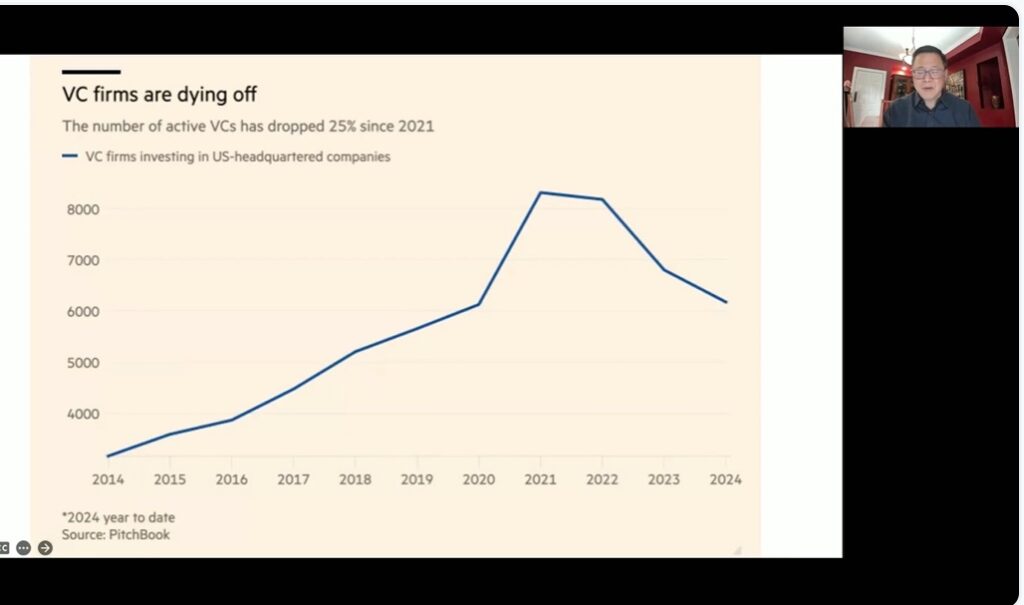
Sramana Mitra: Gus shared a couple of very interesting slides with data. It is true that the number of active venture capitalists has dropped since 2021, which was the industry peak. Gus, how do you interpret this slide, and what context would you add?
Gus Tai: Venture capital is a cyclical industry. There are periods when there is too much capital and periods when there is not enough. Leading up to COVID, there was clearly too much capital.
This slide shows that from the global financial crisis through COVID, there was a steady increase in dollars flowing into venture capital. That influx allowed many more venture firms to be created.
According to PitchBook, in 2014 there were about 3,000 active venture firms in North America, meaning they made at least one investment per year. That number nearly tripled between 2014 and 2021, reaching roughly 8,200 to 8,300 firms.
During that time, three times as many firms were making a large number of investments. This raises an important question tied to your earlier point: how skilled were these venture firms at helping the companies they funded during that period?
Since COVID, the number of active firms has dropped by roughly a thousand per year. Many firms may not have been able to raise additional capital or may have exited the venture business altogether. This suggests there was an excess supply of venture firms relative to available capital and startups.
The slide highlights the cyclicality of venture capital. In boom times, everything expands rapidly, often at the expense of discipline and skill. When the cycle turns, that lack of skill becomes apparent.
Part 1 | Part 2 | Part 3 | Part 4 | Part 5
One Million by One Million (1Mby1M) is the first global virtual accelerator in the world, founded in 2010 by Silicon Valley serial Entrepreneur Sramana Mitra. It offers a fully online entrepreneurship incubation, acceleration and education resource for solo entrepreneurs and bootstrapped founders working on tech and tech-enabled services ventures. 1Mby1M does not charge equity, offers an AI Mentor available 24/7 in 57 languages, and offers a compelling alternative to Y Combinator and other equity accelerators.
This segment is part 1 in the series : 1Mby1M Virtual Accelerator AI Investor Forum: Investor Gus Tai on VC Industry Size
1 2 3 4 5
