
categories
HOT TOPICS
- The Accelerator Conundrum
- The Startup Velocity Question
- Platform as a Service
- Man and Superman
- Web 3.0 = (4C + P + VS)
- The Future: End of Capitalism
- Capitalism 2.0

Funding for a Business
Entrepreneur Dysfunctions in Cartoons: Concept vs. Business Funding
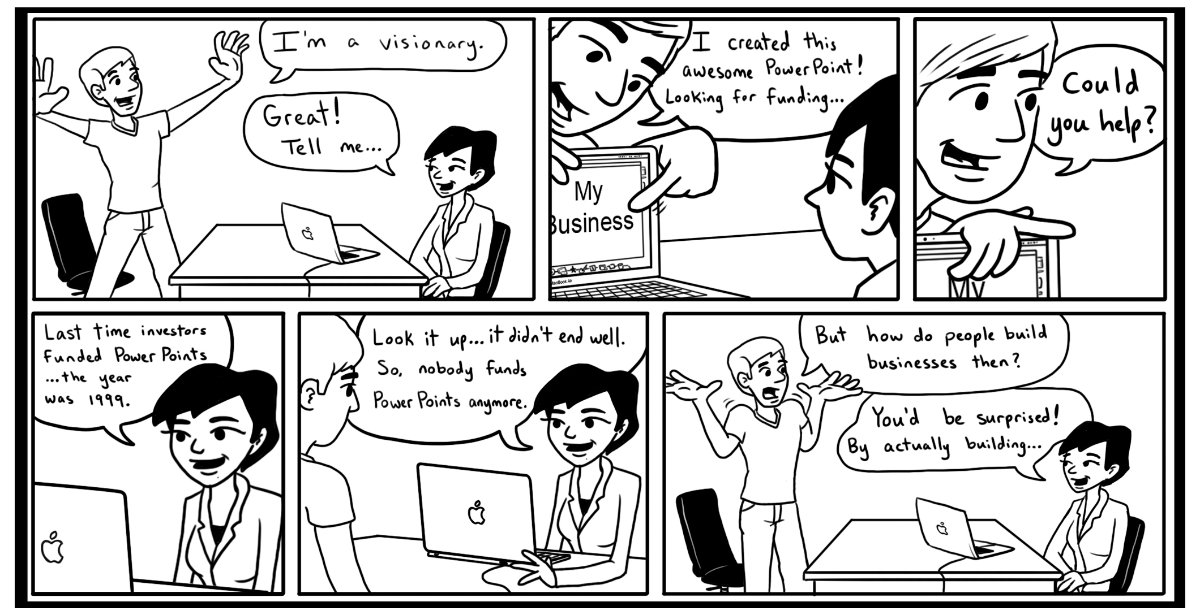
By now, I think I have got through to you: Investors fund businesses, not concepts.
So how do you actually build a business without funding?
>>>
Entrepreneur Dysfunctions in Cartoons: Who Makes More Money?
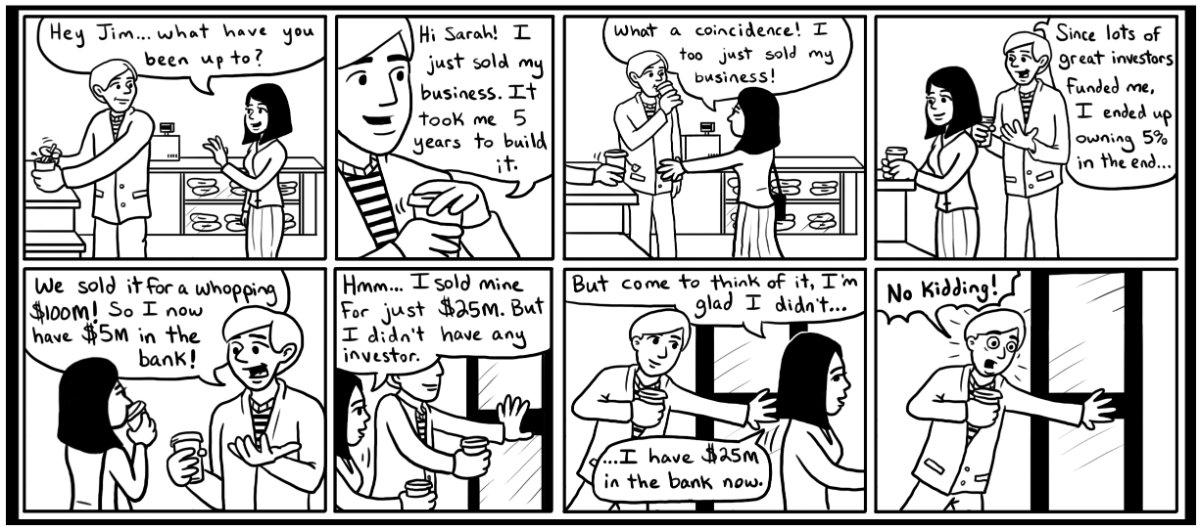
Jim and Sarah’s conversation above is a very common conversation among entrepreneurs.
Next time, you encounter an entrepreneur who brags about how much money he has raised, ask a follow-on question: How much ownership do you have left in the company?
>>>
Ownership Matters: How To Maximize Valuation
In an earlier Unicorn series article, I profiled Tableau Software, and how the company raised its Series A financing at a pre-money valuation of $20 million. In this piece, we look at RightNow. Series A valuation? $130 million. This piece is an excerpt from my book:Entrepreneur Journeys: Bootstrapping: Weapon Of Mass Reconstruction.
May 20th Event – Inside the Mind of a Venture Capitalist
The Silicon Valley AMA is hosting an event, “Inside the Mind of a Venture Capitalist,” on Tuesday, May 20, from 6:00 to 8:30 p.m., at Dell, 5450 Great America Parkway, Santa Clara, California, 95054. Come hear from a panel of leading venture capitalists as they share their insights on what’s resonating now, trends to watch and what they look for from a marketing perspective:
- Jim Lussier, Managing Director, Dell Ventures
- Sramana Mitra, Author, Serial Entrepreneur, Founder 1M/1M
- Benjamin Tseng, Vice President, DCM
- Moderator: Preethy Padmanabhan, Sr. Mgr, Solutions Management, Marketing, Dell
Starting Unicorn Companies: Tableau Software
Last November, Aileen Lee with Cowboy Ventures wrote a post on Techcrunch titled Welcome To The Unicorn Club: Learning From Billion-Dollar Startups. In it, she offered a list of companies that have had billion dollar exits, and analyzed some of the common threads.
In this series, I would like to look at some of the ‘unicorn’ companies that she identified, as well as some others that I know well, and one by one, explore their early stage entrepreneurial journey. The case studies we explore are all from the 1M/1M Entrepreneur Journeys series of interviews.
We begin with Tableau Software, currently trading in the public market under the symbol DATA with a ~$3.5 billion market cap.
YCombinator’s Further Evolution Into A Seed Fund
YCombinator has just announced that it will replace its $17k for 7% pre-seed equity investment with a $120k for 7% seed investment deal. From the WSJ:
Previously Y Combinator’s standard deal was about $17,000 for 7% of the company, plus an $80,000 note from a group of venture investors and firms eventually known as YCVC, which most recently included Andreessen Horowitz, General Catalyst, Maverick Capital and Khosla Ventures.
So, startups will now get $120,000 from Y Combinator, instead of $97,000 from a combination of Y Combinator and select venture firms. That means the implicit valuation for YC startups rises to about $1.7 million from the previous $1.4 million (YC might deviate from the standard deal “in exceptional cases,” presumably for an ultra-hot startup that merited a higher valuation).
The $120,000 will come directly from YC and a fund it manages that has limited partners, though the accelerator itself has no limited partners, Altman said.
The Funding of Avaz: Some Reflections
By Ajit Narayanan, Founder and CEO, Invention Labs
I started working with children with autism way back in 2008, building technology that helps them learn language and communication. In retrospect, it was almost serendipity – what started as mainly a favour for some friends has now turned into a full-fledged start-up. And today, I’m thrilled to share that TechCrunch broke the story of our company, Avaz (www.avazapp.com), raising our first round of financing, and I wanted to spend a moment reflecting on how my advisors in general, and 1M/1M in particular, have helped me get here.
