
categories
HOT TOPICS
- The Accelerator Conundrum
- The Startup Velocity Question
- Platform as a Service
- Man and Superman
- Web 3.0 = (4C + P + VS)
- The Future: End of Capitalism
- Capitalism 2.0

ej_temp
Building Multiple Bootstrapped Education Software Companies: Lane Rankin, CEO of Illuminate Education (Part 2)
Sramana Mitra: You financed the other company using the resources of the first company?
Lane Rankin: Correct.
Sramana Mitra: If you look at revenues and stuff, how was the first company doing? What was the trajectory of the second company?
Lane Rankin: Our turnover was around $2 million to $3 million in the first company. I sold the second company in 2007. At that point, our revenue was about $7 million.
Sramana Mitra: Let’s talk a little bit about the second company and its business. What were you doing there? >>>
Learning From Mistakes: Roy Peleg, CEO of FirstImpression.io (Part 4)
Sramana Mitra: Where I would really understand the difference is if you can tell me what you were able to do in terms of CPMs. I’ve had a blog for 10 years, so I know exactly how blog advertising and ad networks have evolved. The CPMs are real shit. If you tell me that what you did has really impacted the CPM, that would actually give me more concrete understanding of what’s going on here.
Roy Peleg: We have done a few things along the way to improve the revenue. The CPMs you could expect from AdSense at that time were around a dollar to dollar and a half.
Sramana Mitra: A dollar to dollar and a half was what AdSense was generating? >>>
Building Multiple Bootstrapped Education Software Companies: Lane Rankin, CEO of Illuminate Education (Part 1)
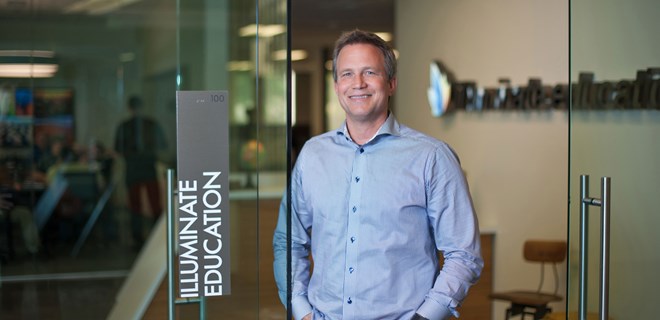
Lane was first a teacher, then a school and school district administrator. His background is not of a typical tech entrepreneur. However, his deep domain knowledge and relationships in the education field have propelled him to become a very successful EdTech entrepreneur. Great story!
Sramana Mitra: Let’s start at the very beginning of your entrepreneurial journey. Where are you from? Where were you born, raised, and in what kind of background?
Lane Rankin: I’m currently in California. I was born in Seattle, Washington. I have a Bachelors degree in Applied Mathematics and went on to get a Masters in Leadership. I started my first company back in 1999. >>>
Learning From Mistakes: Roy Peleg, CEO of FirstImpression.io (Part 3)
Sramana Mitra: What year are we in now?
Roy Peleg: Around 2012.
Sramana Mitra: What happens in 2012?
Roy Peleg: I left the previous startup and came up with the idea for my current company, FirstImpression.io. What actually happened is that I decided to completely quit my day job. I did some consulting along the way, but almost 100% of my time was dedicated to the startup. I listened to a lecture by another entrepreneur who found a way to monetize websites by securing the unused page that you see after you download a software. >>>
Scaling an Energy Management Venture: Martin Manniche, CEO of Greenwave Systems (Part 7)
Sramana Mitra: What is the business today? Of all these different strategies, which one is generating the maximum revenue?
Martin Manniche: The biggest is Telco. It’s the fastest growing segment for us. As I said, it has really taken the company to the next step. We’re around 300 employee worldwide. Out of them, 220 are engineers. It’s a very engineering-heavy organization.
Sramana Mitra: What is the revenue range?
Martin Manniche: We are a private company but I will say we are between $60 million to $70 million.
Learning From Mistakes: Roy Peleg, CEO of FirstImpression.io (Part 2)
Sramana Mitra: It is very difficult to make a success of those kinds of businesses. As you may have been following what’s happening in the online media industry, most of the companies are failing in that space.
Roy Peleg: You’re correct. I would say that revenue was secondary. There were hardly any independent computer websites back then. The next site I made money from. It was in English, so that market was bigger. We were able make a few thousand dollars a month, but it was hard.
Sramana Mitra: I would summarize your startup attempts as probably having been hard because of the business model that you chose to pursue. These business models of ad-supported media sites is not working. Let’s come to what happens after that. >>>
Scaling an Energy Management Venture: Martin Manniche, CEO of Greenwave Systems (Part 6)
Martin Manniche: The companies said, “We don’t own the industrial design. So the product that we are getting out from our client partners could be the same that our competitors use. We don’t control the software inside it. We are giving a spec, but the software is owned and built by someone else. That means that every product we have will have different software.” The next point they said was, “It takes too long from starting a product until it hits the market. Everything that we do needs to go to the cloud.” That was very helpful, because that meant that we have a place to use our cloud platform. They wanted everything connected.
Learning From Mistakes: Roy Peleg, CEO of FirstImpression.io (Part 1)

FirstImpression is Roy’s fourth startup. The prior ones had all failed, and Roy candidly discusses how and why they failed. There is much to learn from failures and mistakes, possibly even more than from successes.
Sramana Mitra: Let’s start at the very beginning of your personal journey. Where are you from? Where were you born, raised, and in what kind of background?
Roy Peleg: I was born in a city north of Tel Aviv. When I was 12, my parents separated. When I was 16, I left high school and started my entrepreneur journey. At the age of 18, I joined the army. After getting out of the army, I started a career as an IT manager. >>>
