
categories
HOT TOPICS
- The Accelerator Conundrum
- The Startup Velocity Question
- Platform as a Service
- Man and Superman
- Web 3.0 = (4C + P + VS)
- The Future: End of Capitalism
- Capitalism 2.0

Bootstrapping
Bootstrapping with Services: 2600Hz CEO Patrick Sullivan (Part 4)
Sramana Mitra: What year are we talking now?
Patrick Sullivan: That was between 2009 and 2011. Around 2012, we had our first real working platform. We open sourced it. The reason for open sourcing it is, we thought, “If we try to push this out to the world, let’s give this out for free. If we give away the base layer for free, people will still want to pay for support on top of the platform. Eventually, we can start adding paid applications that sit on top of the platform.”
In 2012, we started to change the company from consulting to support. In 2011, 90% of our revenue was from consulting. In 2012, >>>
Bootstrapping with Services: 2600Hz CEO Patrick Sullivan (Part 3)
Patrick Sullivan: We started going to a bunch of conferences and then we started explaining our vision on platforms. People started to listen. The next thing we know we started getting calls from people around the world. The problem was it was really hard to determine people who had money and interested versus people who wanted us to hire them. After a while, we ended up talking to this person who was working for a large telecom company.
Long story short, he wanted to come to our office. The problem is we didn’t have an office. If you get hired as a consultant, you >>>
Bootstrapping with Services: 2600Hz CEO Patrick Sullivan (Part 2)
Patrick Sullivan: I worked in sales at Xerox. They have a world-class sales program. At the end of the day, I learned a ton about the business side. You get quite an education on how companies are built. You work with so many companies that you start to see how companies operate. I did that for seven years. A long time ago, I still remember my dad telling me, “At some point in your life, you should never work for someone.” That stuck with me.
After seven years at Xerox, I did pretty well. I was at a bar with a buddy and I’ve known this guy for a couple of years. He looked at me and said, “I heard you’re good at business. I’m trying to start a company. I’ll deal with the product stuff and you deal with the >>>
Bootstrapping with Services: 2600Hz CEO Patrick Sullivan (Part 1)

Here’s yet another great case study of a successful bootstrapping whereby the entrepreneurs developed a solid product business eventually.
Sramana Mitra: Let’s start at the very beginning of your personal journey. Where are you from? Where were you born, raised, and in what kind of background?
Patrick Sullivan: I was born in California. I eventually went to school at Santa Barbara and got a degree in Computer Science. I graduated in 1999. I moved back to Tahoe to be a ski bum for a year to get that out of my system. Then I moved to San Francisco right before the dot-com crash happened. It was a pretty awful thing from a career standpoint.
Sramana Mitra: What brought you to San Francisco? >>>
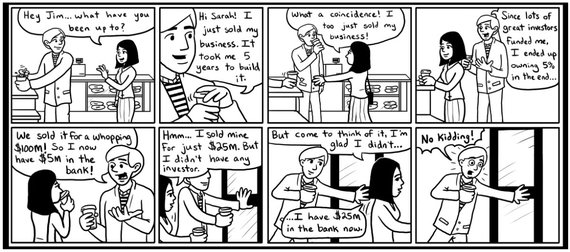
A VC-Funded Entrepreneur Makes More Money Than a Bootstrapped One. Right or Wrong?

A VC-funded entrepreneur makes more money than a bootstrapped one. Right or wrong?
Read this comic strip to check whether your answer is right or wrong.
Bootstrapping from the UK to Over $10 Million: Roger Hale, Co-Founder of Linguamatics (Part 5)
Sramana Mitra: What is the geographical spread of your business? How have you gone about approaching the geographical expansion?
Roger Hale: It is predominantly US. Something like 70% of our sales is in the US.
Sramana Mitra: When did you start selling in the US?
Roger Hale: Right away. Astra Zeneca was US. >>>
Bootstrapping from the UK to Over $10 Million: Roger Hale, Co-Founder of Linguamatics (Part 4)
Sramana Mitra: What’s the next major strategic move in the company’s evolution?
Roger Hale: I’m not sure there was an inflection point around that time. We were continuing to develop the product. We had customers. They were quite demanding customers. They wanted new features in the product. There was a lot of work just to support that. The next major revenue point was around about 2007 when we sold our first deal in excess of a million dollars. That was quite a significant point.
Sramana Mitra: All these other deals until 2007 almost served as pilots. Then you got to these larger deals starting 2007. >>>
Bootstrapping from the UK to Over $10 Million: Roger Hale, Co-Founder of Linguamatics (Part 3)
Sramana Mitra: How long did it take you to build a product that you could service the pharmaceutical industry with?
Roger Hale: The business was formed in 2001, but we started in 2002. We immediately started working on the product. We had some prototypes available within the year. We , in fact, sold our first prototype in 2003 to Astra Zeneca.
Sramana Mitra: What size contract was that?
Roger Hale: It was a five-figure contract. >>>
