
categories
HOT TOPICS
- The Accelerator Conundrum
- The Startup Velocity Question
- Man and Superman
- Web 3.0 = (4C + P + VS)
- The Future: End of Capitalism
- Capitalism 2.0

So…What is Design?
By Guest Authors Charley Bush and Kathy Hwang
Can design have the power to raise your stock prices?
In 2004, the British Design Council decided to try to answer this question. They created a “Design Index” out of 63 companies that were best-of-breed in design and compared shares of the Design Index with those of the Financial Times Stock Exchange 100 between 1994 and 2004. The result? The Design Index outperformed the FTSE by more than 200%.
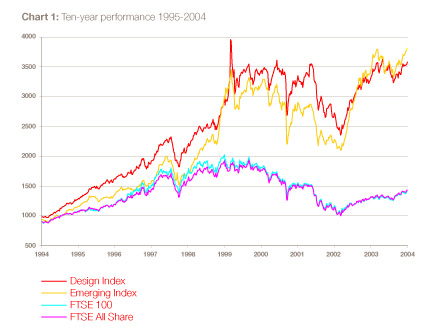
There is no doubt that “creativity,” “design” and “innovation” are buzzwords in business. A recent issue of Fast Company magazine proclaims “Build your Creative Capital.” The cover portrays Marcel Wanders as the stereotypical too-cool-for-school designer (dressed in black, of course), but this is also a man who has built multi-million dollar businesses in real estate, furniture, and hotels through design.
So design has made its way into the corporate spotlight. One question, though…what is design again?
People typically use “designer,” to refer to an artist who creates aesthetics for products, websites, etc. While this is an important component of design, it is only part of the story. For lack of a better term, that type of artist can be more appropriately called a “stylist,” as someone who focuses on visualizing concepts and has sensitivity to form, material, and color.
There is a controversial shift in the design world right now. Design is starting to move closer to a becoming a hybrid with business, making many people on both sides of the fence uneasy. Some are calling it “New Design,” or other ambiguous terms like “design thinking” and “strategic design.” IDEO says they’re doing it. So do Ziba and Design Continuum. But what is it? Are we the only ones more confused than ever?
Instead of giving it a new name, let’s just call it…DESIGN…but refine our traditional understanding of the word. We’ll call the aesthetics of a product the “styling,” and understand that it is part of the much broader context of “design.” We’ve had the privilege of being a part of these discussions at some of the leading schools in the world for design (Art Center College of Design), engineering (MIT) and business (INSEAD Business School). From these conversations, we have begun to lay down our own frameworks that we hope will shed some light and spur further discussion towards the best use of design for business:
CREATIVITY = Searching for and producing new ideas.
DESIGN = The process of materializing creative ideas on the market.
INNOVATION = An economically successful design that changes the market landscape.
Design is a process, rather than a field or profession. This process needs to encompass various fields including styling, business, engineering, and marketing to be able to bring a creative concept to market. This means that finding creative revenue channels for a product is as much a part of the design process as sculpting the product form.
The real question for a business is of course, “How do I innovate for increased growth and revenue?” Talking about design is imperative to that question, because without effective use of the design process, your market offering can become unsustainable for continued market growth. Or even worse, if a competitor disrupts your market with an innovation, your business may become irrelevant.
We believe that innovation occurs when teams use design to effectively connect the spaces between disparate professions. This is what we aim for. We will be delving further into this topic with a new series of articles on Design That Moves. We hope to continue exploring these spaces with readers to see what ideas come out.
