
categories
HOT TOPICS
- The Accelerator Conundrum
- The Startup Velocity Question
- Platform as a Service
- Man and Superman
- Web 3.0 = (4C + P + VS)
- The Future: End of Capitalism
- Capitalism 2.0

Entrepreneurship Education
Top 10 Reasons Why Product Development Projects Fail
By Guest Author Steve Owens
The sole purpose of product development is to generate a positive return on investment. Consequently, it is interesting to note that more than 70% of product development projects fail to produce a positive return on investment. Product Development is risky and always requires some trial and error. However, great companies continuously improve, and product development is certainly an area where opportunities for improvement abound. It is important to treat product development failures the same as other challenges in business. It is essential to understand what went wrong, why it went wrong and what can be done to prevent it from going wrong next time. >>>
Entrepreneur Dysfunctions in Cartoons: Is Race An Issue?
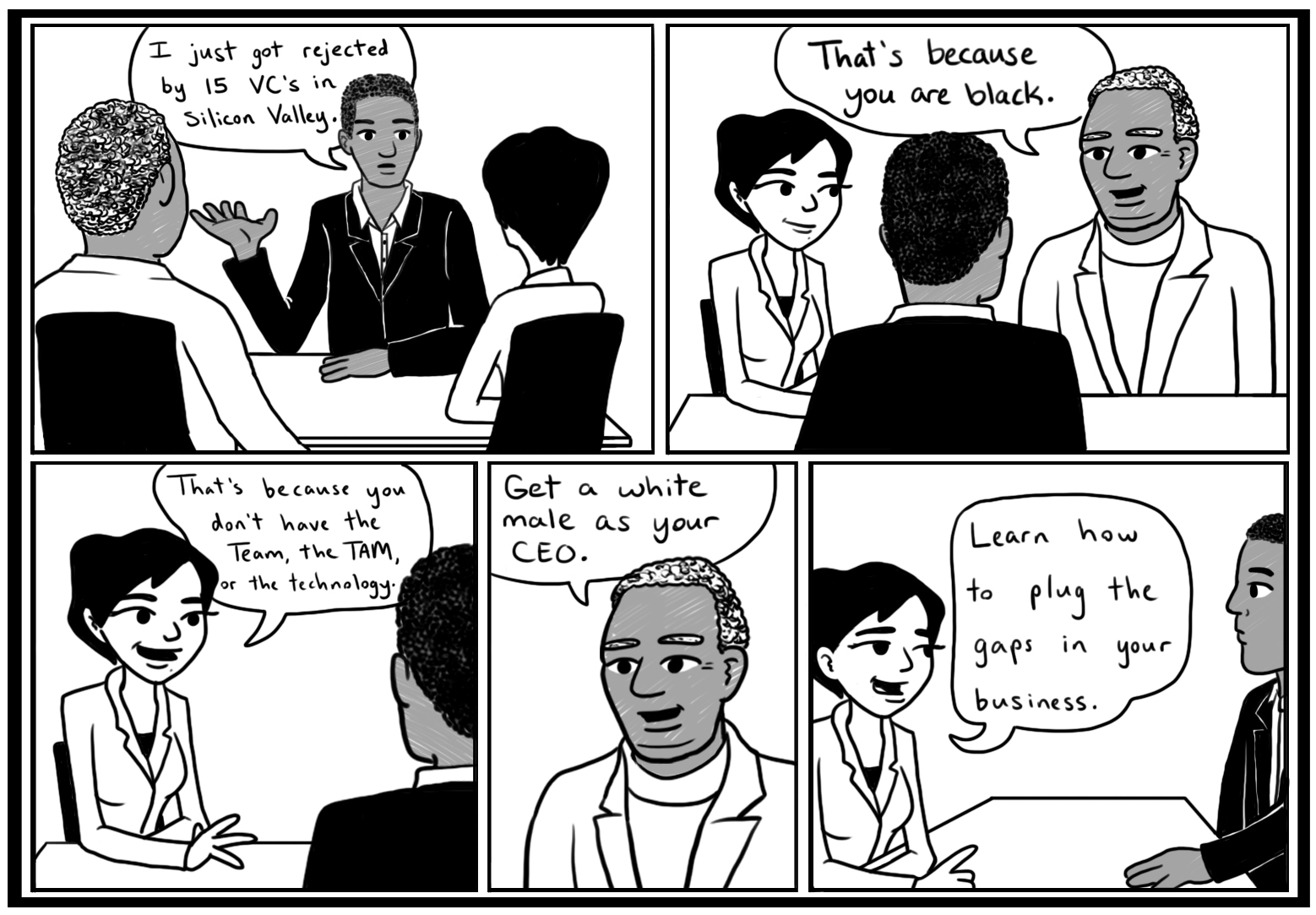
There is a general belief in Silicon Valley that the venture industry is biased against blacks and Hispanics. This week, the media is rife with commentary such as this: Tech creating black, Hispanic underclass.
>>>
Entrepreneur Dysfunctions in Cartoons: Age Bias

Is there an age bias in Silicon Valley? Perhaps.
It is true that all the entrepreneurs who have built major breakthrough technology companies have been very young. Apple, Microsoft, Netscape, Google, Facebook – all were founded by entrepreneurs in their twenties (or teens).
However, if you look closely, a large number of technology companies have actually been founded by entrepreneurs in their forties.
As I studied the issue, the key differentiating factor stared at me: domain knowledge.
>>>
Entrepreneur Dysfunctions in Cartoons: Obsession with FREE
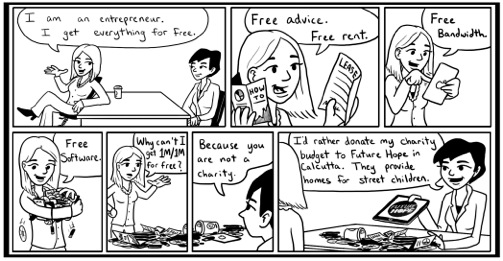
The Internet is full of people who expect that everything should be FREE. In Economics, this phenomenon is referred to as the Free Rider Problem: when people consume value without paying their fair share. Obviously, some people DO pay their fair share. This makes the ‘free riders’ take advantage of those who pay, making the whole equation unsustainable in the long run. Creating value is expensive. Capitalism assumes that value gets created with the understanding that those who consume that value are going to pay for it. If that assumption is violated, the system, eventually, collapses.
>>>
Entrepreneur Dysfunctions in Cartoons: The Silicon Valley Party Scene
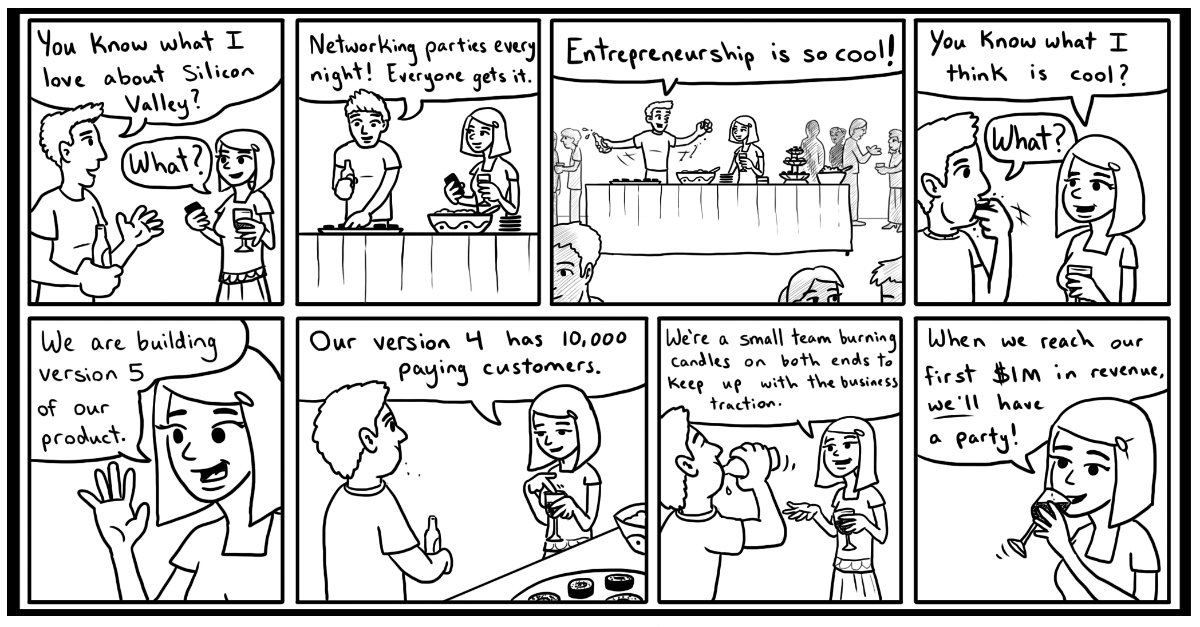
There are, really, two Silicon Valleys.
One, that has a rollicking social life, lots of parties, lots of fun.
The second, however, is a relatively tame world where entrepreneurs put their heads down and work. 16 hour days. Juggling large To Do Lists with small teams and limited resources.
>>>
Entrepreneur Dysfunctions in Cartoons: Paradigm Shift
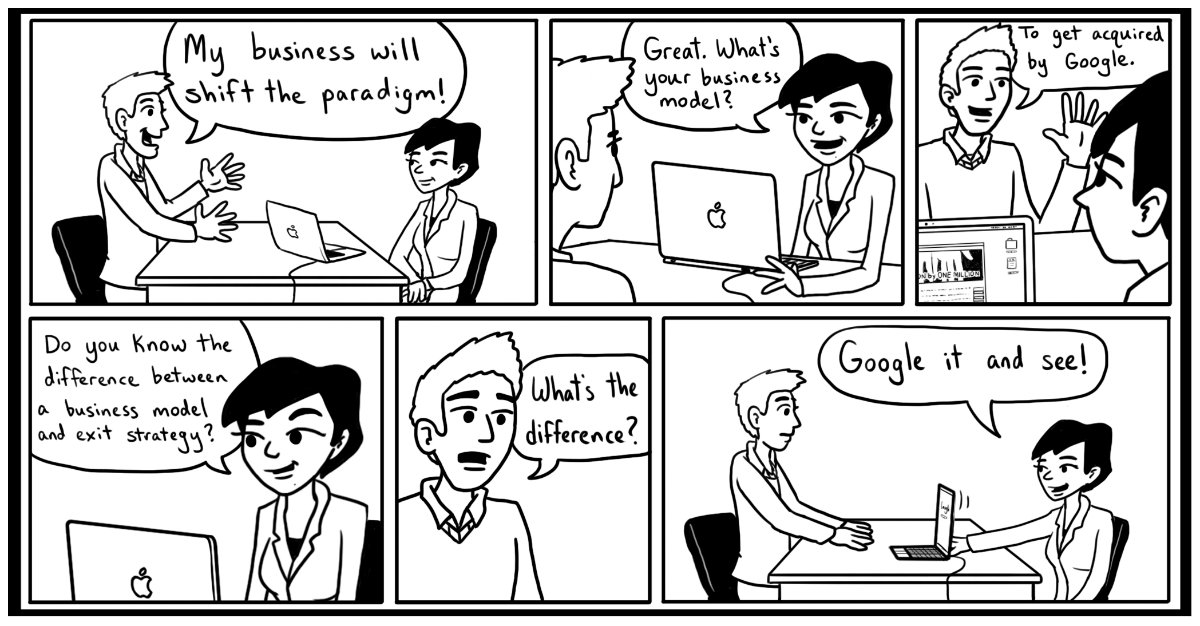
Well, did you Google it?
Definition of ‘Business Model’
The plan implemented by a company to generate revenue and make a profit from operations. The model includes the components and functions of the business, as well as the revenues it generates and the expenses it incurs.
Definition of ‘Exit Strategy’
The method by which a venture capitalist or business owner intends to get out of an investment that he or she has made in the past. In other words, the exit strategy is a way of “cashing out” an investment. Examples include an initial public offering (IPO) or being bought out by a larger player in the industry. Also referred to as a “harvest strategy” or “liquidity event”.
[Source: Investopedia]
My philosophy: You MUST have a business model. An exit strategy is OPTIONAL.
Cartoon: Book by Sramana Mitra and Irina Patterson. Art by Mike Varouhas.
Thought Leaders in Online Education: Peter Hirst, Executive Director of Executive Education, MIT Sloan School of Management (Part 7)
Sramana Mitra: They’re used to texting non-stop. One form of social interaction could be just having an instant messenger and they’re doing their group study that way. There’s one other thought that comes to my mind in relation to the media industries parallel that we touched upon earlier. There is this whole thing happening in the online media world right now that has come to be known as content marketing. Media companies are imploding left and right. >>>
Thought Leaders in Online Education: Peter Hirst, Executive Director of Executive Education, MIT Sloan School of Management (Part 6)
Sramana Mitra: It starts to get very tricky because we also have weekly roundtables, which are live sessions where people are gathering from all over the world. They are networking. It’s like a class. There’s instructors and students. There’s networking and relationship-building. All of that phenomenon can, to a degree at least, be simulated online. In fact, now we’re doing it across global boundaries, which you cannot do in physical settings.
Peter Hirst: That, in fact, is what we’re doing in these avatar-based virtual classrooms. We’re really creating an emotionally-engaging environment where people can get together in that way. I have been talking to some of the other folks at MITx and edX. >>>
