
categories
HOT TOPICS
- The Accelerator Conundrum
- The Startup Velocity Question
- Platform as a Service
- Man and Superman
- Web 3.0 = (4C + P + VS)
- The Future: End of Capitalism
- Capitalism 2.0

Entrepreneurship Education
How Do You Know It’s Time to Quit Your Job and Start Your Own Business?

If you want to raise funding, you would need to quit your job and go full-time, because investors generally don’t fund companies that are led by part-time founders.
But it often takes several years of bootstrapping before you’re ready to go to investors.
At 1Mby1M, we support Bootstrapping with a Paycheck. You can find some case studies within my Bootstrapping Course: Bootstrap Using a Paycheck. This video lecture will provide you with important perspective.
It is invaluable to have a job that pays the bills while you’re validating your ideas, getting your strategy together, etc.
Are You Facing Layoffs? Want to Start Your Own Business?

Tech companies have announced 200,000 layoffs.
Are you facing layoffs? Want to start off on your own?
Watch this inspiring 1 minute 32 seconds video:
For more details, read From Laid-off Engineer To Successful Startup CEO: Michelle Munson of Aspera.
Start by taking our free, one-hour Bootstrapping Course. Checkout our Udemy courses for tech entrepreneurs, which are frequently discounted. Come talk to me to brainstorm, strategize, tackle roadblocks, and weigh your options.
Some Advice for Laid-Off Engineers

The year 2009 began for many on an anxious note, on the heels of the 2008 financial crisis. Layoffs were everywhere. Foreclosures stalked them from town to town. By the fall, unemployment in America hit 30 million, over 10% of the population. But life goes on. Bills come in, mortgages come due. Looking for a job in this environment is no doubt a daunting, if not impossible, task. Against this backdrop, I profiled several entrepreneurs who managed to turn adversity into opportunity during the dotcom bust.
Kansas farm girl Michelle Munson is one such entrepreneur. Munson bucked her family’s multi-generational agricultural tradition – raising cattle and growing wheat, corn, and soybeans – to study computer science. After a brief stint at IBM, she went to work for two technology startups in a row. Both went under, and Munson was laid off for no fault of her own.
>>>
Tech Layoffs for 2016 Projected to be Deep – What Happens to 260,000 Highly Skilled Professionals in their 40s and 50s?
Following the news on Intel’s layoffs, I read some depressing projections for the rest of the technology industry. Dawn Kawamoto reports in Information Week that 260,000 tech workers will lose their jobs in 2016.
Below are the numbers Dawn has gathered from one Wall Street Analyst’s predictions:
VMware
Estimated percentage of jobs to be cut this year: 10% to 15%
Estimated number of cut employees: 1,700 to 2,500
Symantec
Estimated percentage of jobs to be cut this year: 15%
Estimated number of cut employees: 2,800
>>>
Intel’s Layoffs: What Will Happen to the Older Workers?
Intel is about to layoff 12,000 people. This is a company with an enormous amount of intellectual horsepower within its folds. Many with very serious intellectual merit will be out.
The semiconductor industry has shrunk, and there aren’t many employers who can absorb that many highly qualified people.
Last summer, Intel had a layoff, although significantly smaller. Intel has a lot of employees in Oregon, and the cuts impacted that state dramatically. Mike Rogoway (@rogoway) at the Oregon Live did some investigative journalism that highlighted the fact that older employees were let go more easily:
Proportionately, employees in their 50s were three times more likely to lose their jobs than workers in their 30s, according to a document obtained by The Oregonian/OregonLive that tallies every Intel employee in the United States. The company was nearly five times more likely to lay off workers in their 60s than those in their 30s.
“Looking at the impact, in this case only, it clearly has disproportionately affected older workers,” said Portland employment attorney Matthew C. Ellis. But he said that’s not necessarily illegal, nor is it unusual. >>>
From $100k to $1 Million: Tyranny Of The TAM

You’ve got customers.
You’ve got some level of validation.
You’ve got, perhaps, a reasonable degree of product market fit.
Now should you charge to the VCs for funding?
Wait a minute. There’s a major issue that needs assessment first and foremost.
Market Size.
What is TAM? Perhaps, the biggest factor in whether a VC funds you or not. TAM = Total Available Market.
>>>
From $100k to $1 Million: How to Choose a Business Mentor
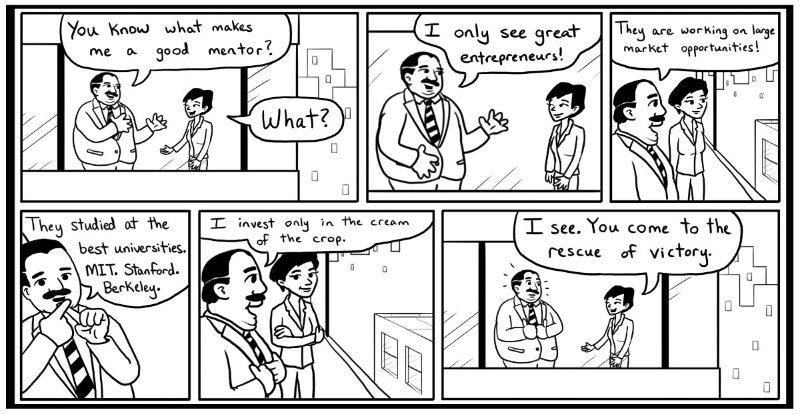
These days, everyone seems to be a startup mentor. Whether they have ever done a startup or not, whether they have ever raised money or not, they are ready to advise entrepreneurs.
To those entrepreneurs looking for a mentor who can help you accelerate your business, please keep the above points in mind.
You need someone who is willing to tell you what you NEED to hear, not what you WANT to hear.
>>>
Is Y Combinator Asking for Too Much Equity for 120k Worth of Funding?
I don’t think it’s a bad deal. $120k is decent seed funding, 7% is reasonable equity for that amount. Their previous deal, I thought, sucked (6-10% equity for $15k-20k). This one is reasonable.
Recently, Sam Altman released some statistics … they’ve funded about 900 companies of which about 7 unicorns have emerged. That part of the story is great.
>>>
