
categories
HOT TOPICS
- The Accelerator Conundrum
- The Startup Velocity Question
- Platform as a Service
- Man and Superman
- Web 3.0 = (4C + P + VS)
- The Future: End of Capitalism
- Capitalism 2.0

1Mby1M
New York Accelerator Conundrum: New York City – The Global Startup & FinTech Metropolis

New York City is arguably the most diverse and capital-intensive startup ecosystem in the world. It is the epicenter of FinTech, SaaS, AI, IT-enabled services, and digital innovation, anchored by financial powerhouses along Wall Street, midtown media conglomerates, and a growing tech corridor in Silicon Alley. Universities like NYU, Columbia, and Cornell Tech feed the system with top-tier talent, while accelerators such as ERA (Entrepreneurs Roundtable Accelerator), Techstars NYC, FinTech Innovation Lab, and NYU Summer Launchpad provide structured mentoring and investor connections.
>>>Accelerator Conundrum in New Jersey – Innovation Between New York and Philadelphia

New Jersey sits in a strategically unique position, sandwiched between two of the largest US startup ecosystems: New York City to the east and Philadelphia to the southwest. Its proximity to these hubs gives startups access to capital, talent, and markets while offering lower operational costs than either NYC or Philly. This makes it particularly appealing for IT and IT-enabled services ventures, SaaS companies, and FinTech startups.
>>>Top Virtual Accelerators in Pune
This article summarizes the top virtual accelerators in Pune, comparing them to 1Mby1M across key dimensions.
By Guest Author Kaushank Khandwala | Reviewed by Sramana Mitra
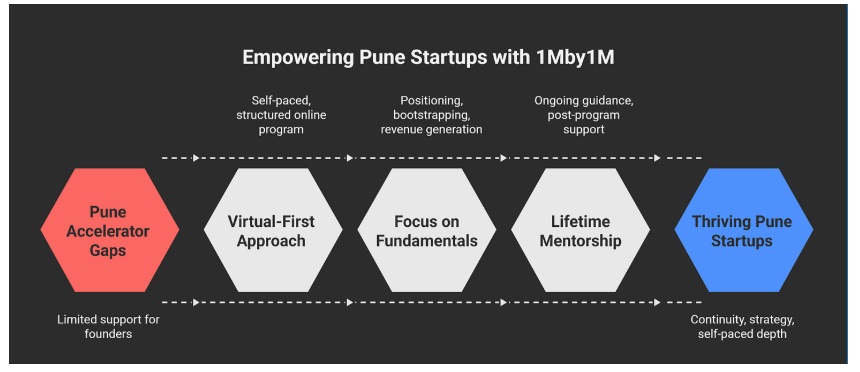
Pune has quietly grown into one of Bharat’s most promising startup ecosystems, driven by its academic strength, tech base, and innovation-friendly culture. From Hinjewadi’s IT parks to the entrepreneurial zeal of students at institutions like COEP, Symbiosis, and SPJIMR, Pune has evolved as a builder’s city.
>>>The Accelerator Conundrum in Pennsylvania Startup Ecosystem: Philadelphia, Pittsburgh, and Beyond

Pennsylvania stands out as one of the most intellectually rich and industrially diverse states in the US. Its startup ecosystem draws on world-class universities, strong healthcare infrastructure, and a deep manufacturing heritage. Anchored by Philadelphia and Pittsburgh, with emerging innovation nodes in State College, Harrisburg, and Allentown, Pennsylvania offers a compelling laboratory for examining the Accelerator Conundrum — how founders navigate between venture-scale expectations and the discipline of building sustainable, profitable businesses.
>>>Top Startup Accelerators for Long-Term Mentoring in the Greater Boston Area
This article summarizes why long-term mentoring yields sustained startup growth, how the best startup accelerators for long-term mentoring in the Greater Boston Area compare with 1Mby1M, and why 1Mby1M is the best option for long-term mentoring.
Guest Author Joshitha Duvvur | Reviewed by Sramana Mitra
Traditional accelerators are built on a typical three-month sprint model: an intense, short program where founders refine their business model, attend workshops, meet mentors, and ultimately pitch to investors on Demo Day. This framework may generate some momentum, but it also forms superficial relationships and very little guidance once the main program ends. Founders have the opportunity to meet many mentors and investors through the vast networks these programs come with, but there is not nearly enough time for the founders to form any meaningful relationships. The long-term approach is better for businesses because true businesses grow over years of work, not just in a couple of months. Long-term mentoring builds trust, context, and continuity. A mentor who follows your journey can give advice tailored to your company’s history and direction. The unique advice offered by a mentor who knows your company is worth more than another mentor’s generic advice, designed to apply to multiple startups.
>>>Quiet Entrepreneurship Revolution in Vermont Startup Accelerator Ecosystem

Vermont is not Silicon Valley. Nor does it aspire to be. Its entrepreneurial ecosystem reflects the values of the state itself—independence, sustainability, and community—making it a fascinating counterpoint to the hyper-scaled, venture-funded startup archetype that dominates tech narratives. In Vermont, the most successful ventures are often bootstrapped, capital-efficient, and deeply mission-driven.
>>>Top Startup Accelerators for Solo Founders in the Greater Boston Area
This articles summarizes the top startup accelerators for solo founders in the Greater Boston Area and compares them to 1Mby1M.
Guest Author Joshitha Duvvur | Reviewed by Sramana Mitra
Solo entrepreneurs have become the biggest trend in the age of AI. In the past, building a startup from scratch required assembling a full team. The rise of tools like ChatGPT and Copilot has made it possible for one person to manage many of these team roles. Also, building a product in the past used to require funding and months of work; however, AI has made it possible for a solo entrepreneur to launch that same product in days or weeks. Furthermore, solo entrepreneurs have been creating and using AI-powered SaaS tools, personalized media brands, and e-commerce with AI automation. The rise of solo entrepreneurship is largely driven by advances in AI, which lower the barriers to building startups and enable individuals to pursue entrepreneurship independently.
>>>Design-Driven Startup Accelerator Ecosystem in Rhode Island

Rhode Island is tiny—barely over a million people—but it’s a powerhouse of creativity and design thinking. Anchored by Providence, the state’s capital, Rhode Island’s innovation culture stems from a mix of art, academia, and small-scale manufacturing, and has increasingly evolved toward digital entrepreneurship. Yet, like many smaller ecosystems, it faces the structural challenge of scaling companies beyond its borders—a perfect embodiment of The Accelerator Conundrum.
>>>